
How does Disney maintain a relationship with someone from childhood through adulthood?
A customer may first encounter Disney through an animated movie. Years later, that person may subscribe to Disney+, visit a theme park, purchase merchandise, join D23, book a Disney Cruise, or introduce the same characters to their children.
Each interaction appears different.
However, Disney has spent years connecting these experiences through customer accounts, mobile applications, wearable technology, personalized recommendations, loyalty benefits, and emotional storytelling.
The centre of this relationship is MyDisney.
MyDisney allows customers to use one email address and password across many Disney services, including Disney+, Hulu, ESPN, Disney Store, Disney Cruise Line, Disneyland, and Walt Disney World. This gives Disney a consistent identity layer across parts of its enormous entertainment and experiences ecosystem.
At the end of Disney’s 2025 financial year, Disney+ had 132 million subscribers. Disney+ and Hulu had 196 million combined subscriptions, while Disney Experiences generated more than $36 billion in annual revenue.
Disney joins companies such as Apple, Amazon, Nike, and Starbucks in proving that customer relationship management is much broader than storing contact information. You can explore more examples in our collection of CRM case studies from the world’s biggest brands.
This Disney CRM case study examines the technology behind the company’s customer relationships, how Disney connects digital and physical experiences, the role of personalization, and what other businesses can learn from its approach.
“It’s our fans that keep the spirit of Disney alive year after year, generation after generation.”
– Bob Iger
History of Disney: Timeline and Important CRM Milestones
Walt Disney and Roy Disney established the Disney Brothers Cartoon Studio.
Disneyland opened in Anaheim, California. The park transformed Disney from a company that primarily told stories through screens into a company that allowed customers to enter those stories physically.
Walt Disney World opened in Florida. The larger resort model allowed Disney to extend the customer journey across hotels, transportation, dining, entertainment, shopping, and several days of park experiences.
Disney launched D23, its first official fan community.
Disney introduced the original MagicBand at Walt Disney World.
Disney+ launched. The service gave Disney a direct subscription relationship with viewers instead of depending entirely on cinemas, television networks, and licensed distributors.
Disney launched Disney MagicMobile for supported Apple devices.
MagicBand+ launched at Walt Disney World and Disneyland Resort.
Disney introduced MyDisney as a more visible, unified login experience. Customers could begin using one email address and password across compatible services such as Disney+, Hulu, ESPN, Disney Store, Disney Cruise Line, Disneyland, and Walt Disney World.
Disney launched an ongoing Disney+ Perks program in the United States.
Disney+ introduced a redesigned application experience with a For You section that provides recommendations based on viewing behaviour.
Before you proceed, you can get instant, no-obligation CRM quotes. Just answer a few quick questions and we’ll match you with top providers tailored to your business.
What CRM Does Disney Use?
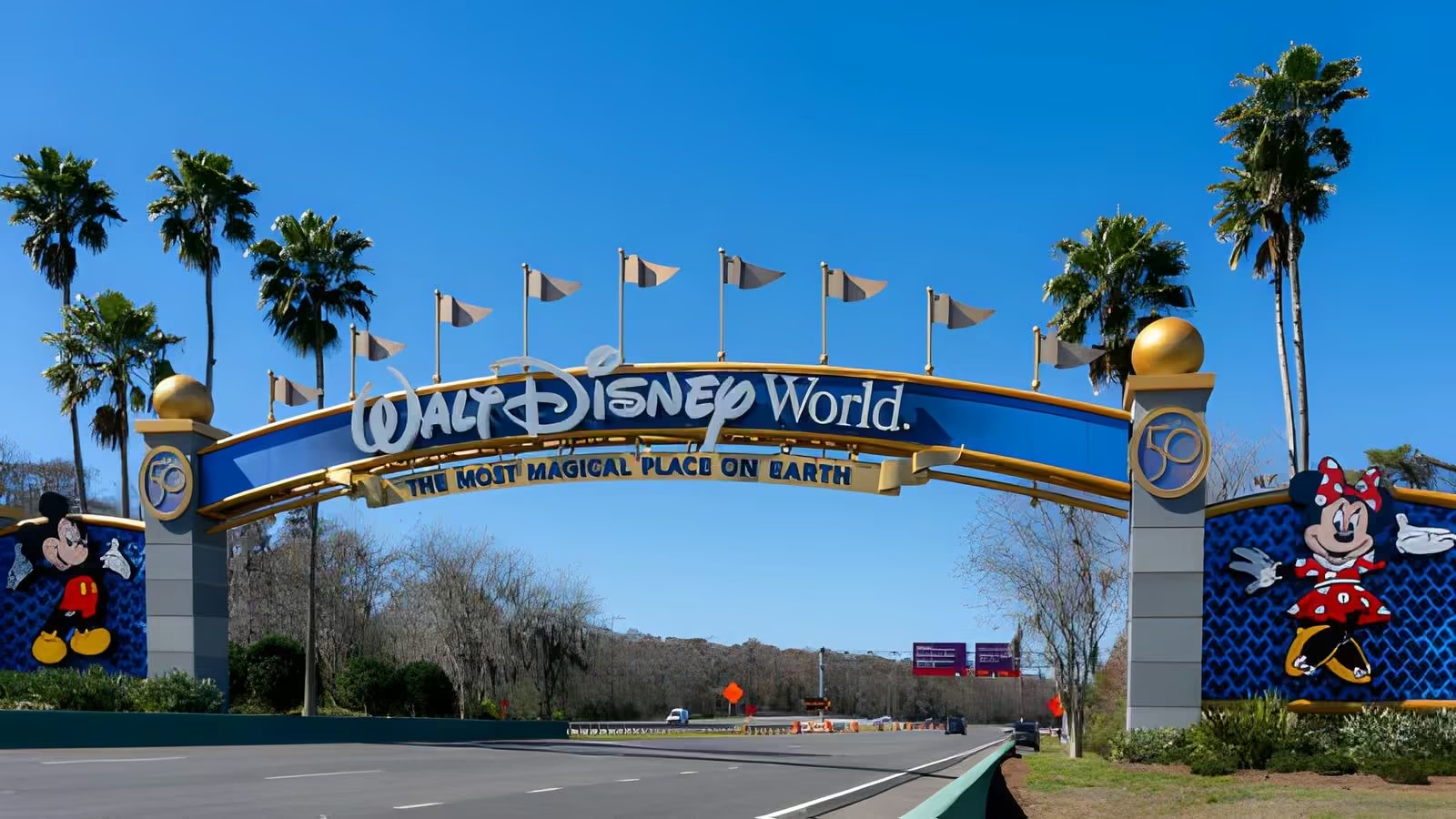
Disney does not publicly identify one customer relationship management platform that controls every customer interaction across its entire business.
That would be difficult for a company operating theme parks, streaming services, television networks, film studios, sports platforms, cruise ships, hotels, retail stores, games, fan communities, and consumer products.
Disney’s CRM should therefore be understood as a connected customer experience ecosystem rather than one software product.
The ecosystem includes MyDisney, My Disney Experience, MagicBand, Disney+, Hulu, ESPN, D23, Disney+ Perks, mobile applications, customer service systems, data platforms, and selected enterprise tools.
5 Ways Disney Uses Customer Relationship Management
1. MyDisney Turns Separate Accounts Into One Customer Identity
Disney’s business contains many customer touchpoints. For instance, a person may subscribe to Disney+, follow a sports team through ESPN, book a Walt Disney World vacation, purchase merchandise from Disney Store, and later reserve a Disney Cruise.
Without a shared identity, each interaction may appear to belong to a different customer. Reason why MyDisney attempts to reduce that fragmentation.
Customers use the same email address and password across many compatible Disney services. Funny enough, the customer benefits because there are fewer usernames and passwords to remember.
On the other hand, Disney benefits because the shared identity creates the foundation for a more connected understanding of the relationship.
Consider a family that uses Disney+ throughout the year and later books a theme park holiday. The streaming interaction and the vacation purchase happen through different services, but MyDisney makes it easier to recognize that both activities belong to the same account holder.
This does not automatically create a perfect customer profile. Disney still has to manage permissions, privacy requirements, regional rules, child accounts, duplicated email addresses, and systems developed by different business units.
However, identity is the first requirement for connected CRM.
A company cannot build a reliable customer history when it cannot tell whether two interactions belong to the same person.
This is similar to Nike’s membership model. Our Nike CRM case study explains how Nike accounts connect customers to shopping, exercise applications, content, products, and membership benefits.
The lesson is straightforward. Before a company can personalize the relationship, it must first recognize the customer consistently
2. My Disney Experience Organizes the Entire Vacation Journey
A Disney vacation contains dozens of decisions.
Customers may need to choose a resort, purchase tickets, select travel dates, reserve restaurants, understand transportation, plan attractions, check waiting times, order food, locate family members, and manage photographs.
When these tasks are spread across disconnected systems, the customer experience becomes stressful.
My Disney Experience brings several parts of the journey into one application.
Customers can use it before arriving, while inside the resort, and after completing the trip.
Before the visit, the application supports planning. During the visit, it provides maps, attraction information, dining, mobile ordering, PhotoPass, account services, and other tools. And after the visit, customers may continue accessing photographs and account information.
The application benefits Disney in several ways: It reduces the number of basic questions that employees must answer, gives Disney information about what customers are planning, allows the company to communicate service updates, makes it easier to offer dining, accommodation, photographs, and other experiences, and also provides intent signals.
A person who reserves a restaurant, saves an attraction, or checks a resort page is showing interest in a specific part of the experience. Disney can then use those signals to improve planning tools and present relevant information.
This resembles the omnichannel strategy examined in our Walmart CRM strategy. Walmart uses customer accounts and mobile tools to connect physical stores, ecommerce, delivery, payments, and membership services.
Disney applies the same principle to travel and entertainment.
Travel businesses trying to organize similarly complex customer journeys can compare platforms in our guide to the best CRM software for tour operators.
3. MagicBand Connects Digital Profiles to Physical Experiences
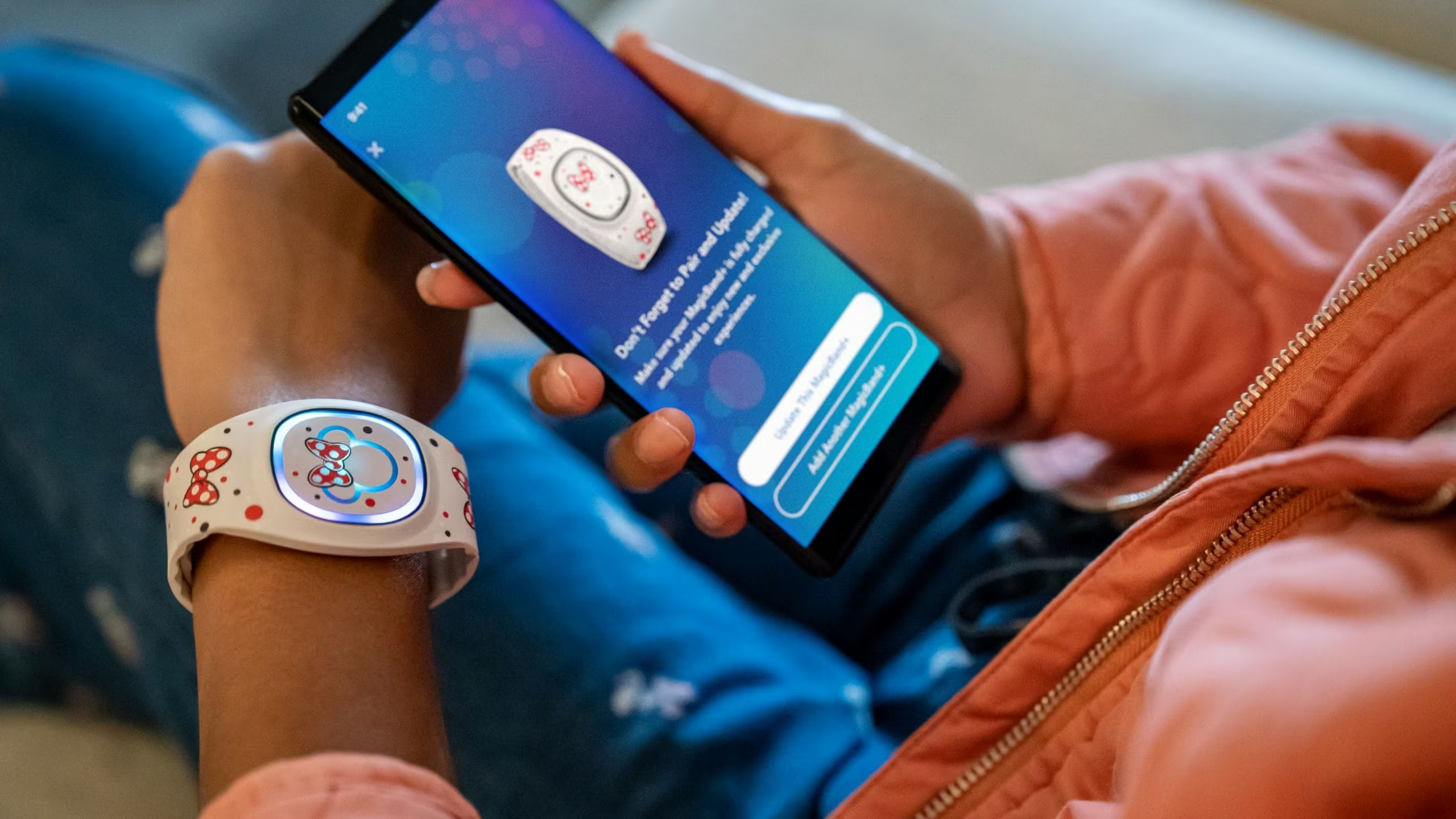
CRM normally exists inside screens. But Disney extends it into the physical environment.
MagicBand allows a guest to connect an account to park entry, a hotel room, PhotoPass, attraction access, dining, and selected transactions.
The customer does not need to present a different document for every interaction. A tap of the wrist can complete several tasks. That convenience is part of the value exchange.
The customer agrees to use a connected device. Disney uses the device to reduce friction and provide relevant services.
MagicBand can also make experiences feel personal.
Disney states that selected park technologies may recognize compatible devices and provide interactive or personalized experiences. The most important CRM lesson is not the wristband itself. It is the connection between the customer profile and the physical environment.
Many businesses collect customer data online but lose the relationship when the person enters a physical location. While Disney attempts to preserve the identity across both environments.
A customer’s ticket, room, photographs, and purchases can be connected to the same account used during digital planning. Thereby creating a more complete customer history.
Retail businesses apply a similar principle when they connect ecommerce accounts to store purchases. Our guide to the best CRM software for online retail examines platforms designed to centralize online and offline customer information.
MagicBand also demonstrates that data collection works best when it solves a customer problem. That is, guests receive convenience, speed, automation, and access. And Disney receives better visibility into how customers use its services.
4. Disney Creates Loyalty Through Access and Belonging
Disney does not operate one universal loyalty program that covers every product and service. Instead, it creates different communities and benefit programs around specific types of relationships.
D23 is designed for highly engaged Disney fans.
Disney+ Perks gives streaming subscribers access to offers and experiences.
Disney Visa products provide rewards and benefits linked to Disney purchases and vacations.
Theme park annual passes reward repeat visits.
Disney Vacation Club supports long term relationships with customers who regularly visit Disney destinations.
These programs use different mechanisms, but they share one principle. Loyalty is built through access.
Customers may receive exclusive content, special events, discounts, early information, merchandise, rewards, or experiences that are not available to everyone.
D23 was created as Disney’s first official fan community in 2009. It offered members access to stories, publications, events, and the D23 Expo. Then in 2025, Disney+ introduced its ongoing Perks program with partner discounts, sweepstakes, and opportunities connected to movies, cruises, games, and other experiences.
This is different from a basic points program. Disney is not only giving customers a cheaper transaction. It is making them feel closer to the stories, characters, creators, and experiences they care about.
Businesses managing communities can explore the platforms in our guide to the best CRM for membership organisations.
Starbucks uses a different loyalty model based on purchases, rewards, and mobile convenience. Our Starbucks CRM strategy explains how a company can turn frequent transactions into an ongoing customer relationship.
Disney shows that loyalty can also be emotional. Customers remain because they want to belong to the world surrounding the product
5. Disney Uses Behaviour to Trigger Relevant Communication

Customer information becomes useful when a company can act on it.
Disney Streaming Services has publicly described using Amazon Pinpoint to create customer segments and campaigns in real time. The platform could support more than 300 segments and campaigns in an hour and more than 20 in a minute during demanding periods.
After campaigns were sent, Disney Streaming Services analysed how customers interacted with notifications.
Engagement information was streamed through Amazon Kinesis and stored for further analysis. This allows communication to respond to customer behaviour.
A sports fan may receive information about a selected team. A viewer may receive a reminder about new content connected to a series they watched. A subscriber may receive information about an account, payment, or service event. A park guest may receive an update connected to a reservation or scheduled activity.
The customer is more likely to respond when the message reflects something they have actually done. That is different from sending the same campaign to every account.
Behavioural segmentation can be simple. A business may separate customers according to: products viewed, content watched, services booked, time since the last purchase, incomplete registrations, abandoned carts, previous support requests, membership status, and communication preferences.
The information must still be accurate and handled responsibly.
Our guide to CRM data management best practices explains how organizations can improve the accuracy, security, storage, and reporting of customer information.
Results of Disney’s CRM Strategy
132 Million Disney+ Subscribers
Disney reported 132 million Disney+ subscribers at the end of its 2025 financial year. The number had increased by 3.8 million from the previous quarter.
This gives Disney a large direct customer base.
The company can learn how audiences discover and engage with content without depending entirely on third party television channels or cinema distributors.
196 Million Disney+ and Hulu Subscriptions
Disney reported 196 million combined Disney+ and Hulu subscriptions at the end of the same period.
That represented an increase of 12.4 million from the previous quarter.
Disney has continued bringing Hulu and ESPN content into the Disney+ environment, making it easier for customers to access more of the company’s content through fewer applications.
$1.3 Billion in Streaming Operating Income
Disney’s entertainment direct to consumer business generated approximately $1.3 billion in operating income during financial year 2025.
This represented an important change from the significant losses Disney’s streaming business recorded during earlier years.
CRM cannot take full credit for the improvement.
Pricing, advertising, content costs, subscriber growth, bundles, and operating efficiency also contributed.
However, personalization, account management, customer retention, and direct communication are essential parts of a profitable subscription business.
More Than $36 Billion in Experiences Revenue
Disney Experiences generated $36.156 billion in revenue during financial year 2025.
Domestic parks and experiences produced $25.191 billion, international parks and experiences produced $6.520 billion, and consumer products produced $4.445 billion.
Disney’s customer experience ecosystem supports these businesses by connecting planning, accommodation, tickets, dining, photographs, purchases, and customer service.
Record Experiences Operating Income
Disney Experiences generated record annual operating income of approximately $10 billion in financial year 2025.
This represented an increase of $723 million from the previous year.
Disney’s attractions, cruises, hotels, merchandise, pricing, and operational decisions all contributed to the result.
However, its ability to manage complex customer journeys is an important part of the commercial model.
What Businesses Can Learn From Disney’s CRM Strategy
Disney’s scale is unusual, but its customer relationship principles can be applied by much smaller businesses.
1. Build One Recognizable Customer Identity
MyDisney gives customers one login across several services.
Your business may not operate theme parks and streaming platforms, but customers may still interact through a website, email, social media, physical location, support desk, and mobile application.
Those interactions should contribute to one customer history.
Use consistent identifiers such as email addresses, account numbers, membership IDs, or verified phone numbers. The goal is to prevent the relationship from restarting every time the customer changes channels.
2. Design the CRM Around the Customer Journey
Disney’s customer journey begins before a park visit.
It continues through planning, booking, travel, arrival, accommodation, attractions, dining, photographs, purchases, support, and memories after the trip.
My Disney Experience reflects those stages. Your CRM should also reflect how customers actually buy.
Do not copy a generic sales pipeline without adapting it. A customer journey may include discovery, research, consultation, purchase, onboarding, service delivery, support, renewal, and referral.
Your CRM should help customers and employees move through these stages with less confusion.
3. Give Customers Value in Exchange for Data
Customers use MagicBand because it provides convenience.
They create Disney+ profiles because the profiles separate watch lists and recommendations.
They use MyDisney because one login is easier than several passwords.
Every request for information should have a customer benefit.
Do not collect a birth date, location, preference, or phone number merely because the CRM contains a field for it. Explain how the information improves the service.
4. Connect Digital and Physical Experiences
MagicBand brings digital customer information into a physical environment.
Retailers, restaurants, hotels, clinics, schools, and service companies can apply the same principle without wearable technology.
A customer’s online booking should be visible at the physical location.
Store employees should be able to access relevant order information.
Customer service should understand what happened during an in person visit.
Digital and physical teams should not maintain contradictory records.
5. Let Technology Support Human Service
Disney uses applications, recommendations, automation, and wearable technology.
However, Cast Members remain essential.
Your CRM should give employees useful context.
It should not prevent them from using judgement.
Automate repetitive tasks such as data entry, reminders, routing, and simple questions.
Allow people to handle sensitive complaints, exceptions, negotiation, reassurance, and relationship building.
The best system makes employees more helpful.
It does not make customers feel trapped inside a workflow
Conclusions
The Disney CRM case study demonstrates what happens when customer relationship management extends beyond marketing campaigns and contact records.
The strongest lesson is that Disney does not treat every customer interaction as an isolated transaction.
It treats each interaction as another chapter in the same relationship.
A customer may watch a movie today, visit a park next year, and introduce the same story to their children several years later.
Disney’s CRM ecosystem helps the company remain present throughout that journey.
Your business may not have famous characters, theme parks, or 132 million subscribers. However, it can apply the same principle.
Recognize the customer.
Remember the relationship.
Remove unnecessary effort.
Provide relevant value.
Then create an experience worth returning to.
That is the real magic behind Disney’s customer relationship strategy.
Frequently Asked Questions
Disney does not publicly identify one CRM platform that manages every part of the company.
Its customer relationship ecosystem includes MyDisney, My Disney Experience, MagicBand, Disney+, Hulu, ESPN, D23, Disney+ Perks, mobile applications, cloud data technology, and selected enterprise systems.
Disney Studios Content has also entered a confirmed partnership involving Salesforce Customer 360.
Yes.
Disney Studios Content announced a five year innovation partnership with Salesforce in 2021.
The partnership used Salesforce Customer 360 to support production workflows, marketing coordination, and media property performance reporting.
There is no reliable public evidence that Salesforce is the single companywide CRM for every Disney business.
Disney’s CRM strategy centres on connecting customer identities, personalizing content, simplifying park experiences, creating fan communities, rewarding loyalty, and maintaining relationships across several entertainment and travel products.
Small businesses can learn to create one customer identity, connect communication channels, personalize according to behaviour, provide value in exchange for data, build loyalty through belonging, and use technology to support human service
Disney can collect customer information through account registration, subscriptions, purchases, park tickets, hotel bookings, applications, streaming activity, watch lists, location enabled services, wearable devices, customer support, marketing preferences, and loyalty programs.
The information collected depends on the product, customer permissions, age, region, and applicable privacy rules