
When we started hiring outside our home country, it didn’t take long for things to get messy, spreadsheets everywhere, confusing tax rules, and constant questions about whether we were actually compliant. Deel was the tool that pulled all of that into one place and made global hiring feel manageable instead of chaotic. It did not solve every problem overnight, but it removed enough friction that we could focus more on finding great people and less on wrestling with bureaucracy.
In this review, I’ll walk you through how Deel actually works in practice: what it does well, where it gets frustrating, how the pricing feels once you’re using it, and the types of teams it truly makes sense for. By the end, you should have a realistic idea of whether Deel is worth the money for your situation or just another polished platform with strong marketing.
So, What Is Deel (In Real Life)?
The simplest way I’d describe Deel is this: it acts as your legal and payroll middleman so you can hire people almost anywhere in the world without setting up a local company in each country.
On paper, Deel becomes the official “employer of record” for your team members in countries where you don’t have an entity. In practice, that means they handle contracts, payroll, taxes, and local compliance, while you still manage the person’s day‑to‑day work like any other team member. You get the relationship and the output; Deel handles the boring, risky legal and financial parts in the background.
The typical flow looks like this:
you find a candidate, you plug their details into Deel, and the platform generates a locally compliant contract, sets up payroll in their local currency, and makes sure the required deductions and filings are handled. You don’t have to go hunting for local lawyers or payroll providers in every new country. If you also work with contractors or freelancers, you can onboard them, sign agreements, and pay them from the same platform instead of jumping between tools and spreadsheets.
Over time, this all starts to feel like you’re hiring locally, even if your team is spread across Germany, Brazil, Kenya, and Japan—because the admin work is centralized instead of scattered.
What Deel Offers
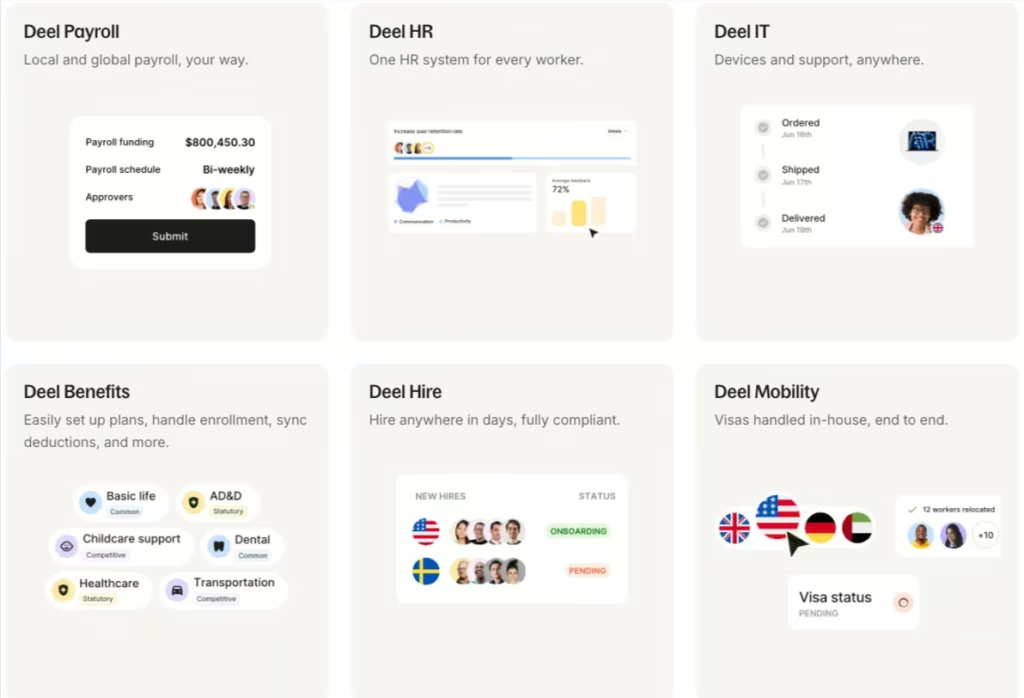
Deel isn’t just one product; it’s a stack of services aimed at making global hiring less painful. The main pieces you’ll come across are:
• Deel Hire: For hiring full‑time employees compliantly in countries where you do not have an entity
• Deel Mobility: For managing visas, work permits, and immigration tasks
• Deel Payroll: For running both local and global payroll from one place
• Deel Services: For support with more complex HR and compliance situations
• Deel HR (HRIS): Deel’s own HR system for managing people data in one dashboard
• Deel Embedded: Infrastructure that lets other platforms plug Deel’s global hiring into their products
• Deel IT: For managing hardware and IT assets for distributed teams
• Deel Benefits: For handling benefits for global employees
You don’t have to use all of this. Most teams start with EOR (employer of record), contractor management, or payroll, then layer in HR and IT tools as they grow.
Key Features (And How They Feel in Use)
1. Consolidated payments in one place
Before using a platform like Deel, it’s common to be paying contractors through different providers and juggling currency conversions manually. With Deel, approvals, invoices, and payments live in one system. You review what people are owed, click to approve, and Deel takes care of paying everyone in their preferred currency.
It’s not just about convenience; it also reduces errors. When all payment data sits in a single dashboard instead of scattered across tools and spreadsheets, it’s much easier to spot anomalies or missing invoices before payroll goes out.
2. Built‑in global compliance
Hiring across borders means every country has its own rules – notice periods, benefits, taxes, contract types, and so on. Deel builds those rules into its workflows. When you issue a contract through the platform, it’s based on local labor laws instead of a generic template you’re hoping is “close enough.”
This doesn’t eliminate every risk, but it dramatically reduces the chances of doing something obviously non‑compliant out of ignorance. For most teams without in‑house legal experts in multiple countries, that peace of mind is one of the biggest reasons they lean on Deel.
3. Payroll compliance and flexibility
Deel manages taxes, deductions, and filings in the background while giving you flexibility in how you structure pay. You can support different worker types; full‑time employees, contractors, and those hired through EOR, and manage them from the same system.
The benefit is that payroll becomes a repeatable process instead of a monthly fire‑drill. Once things are set up correctly, running payroll starts to feel like a series of approvals rather than a manual rebuild every cycle.
4. Time tracking inside the platform
If you work with hourly contractors or project‑based roles, Deel’s time tracking is a useful built‑in tool. People can log their hours directly inside the platform, and you can review and approve before payroll runs.
That means one less subscription to maintain and fewer data transfers between a time‑tracking app and your payroll system. It’s not the most advanced tracking on the market, but for many teams it’s good enough, which is often all you need.
5. Real‑time payroll and workforce analytics
Deel’s reporting dashboard gives you a live view of payroll costs, hiring trends, and basic workforce metrics. When you’re paying people in multiple currencies and countries, having this rolled up in one place matters more than it might in a purely local team.
You can quickly see how much you’re spending per country, how your global team is growing, and how those costs evolve over time. That’s especially helpful for finance and HR teams who need to justify or plan headcount across regions.
6. Location independence without entities
One of the biggest selling points of Deel is that it lets you hire in over 150 countries without registering a local company in each one. Instead of spending months (and a lot of money) setting up entities and then figuring out payroll on top, you can start hiring much faster.
For high‑growth teams, that speed is often worth more than the cost difference between EOR fees and building everything yourself. You can test new markets or hire key individuals where they live instead of forcing relocation.
7. Multi‑currency and flexible payouts
Deel supports payouts via bank transfers, digital wallets, and in some cases even cryptocurrency, with people receiving funds in their local currency. For team members, this feels “normal”—they get paid the way they expect. For you, it means there’s no need to micromanage FX or juggle multiple banking setups just to cover different regions.
8. Mass payment automation
If you pay a large number of contractors or employees, the ability to run bulk payments with a few clicks is a big time saver. Deel lets you automate approvals, currency conversions, and payout flows so that once you’ve set things up, each cycle becomes more of a review and confirm process than a manual rebuild.
Deel Pricing: How It Actually Feels
Deel is not positioned as the cheapest option, and you can feel that once you start looking at EOR pricing. The key is whether the value justifies the cost for your specific stage and level of global complexity.
Here’s a rough idea of their main starting prices:
| Service | Starting price (approx.) | Best for |
|---|---|---|
| Employer of Record (EOR) | Around 599 USD per employee/month | Hiring in new countries without opening local entities |
| Global Payroll | Around 29 USD per employee/month | Startups and enterprises running payroll across multiple countries |
| Contractor Management | Around 49 USD per contractor/month | Teams managing a global network of freelancers and contractors |
For businesses with serious global expansion plans, these numbers can make sense. You’re not only paying for payroll; you’re paying to skip months of legal setup, reduce compliance risk, and centralize a lot of HR operations into a single tool. For very small teams or those hiring just one person abroad, the same pricing can feel steep.
A realistic way to look at it: if you’re hiring a few people in a new country and you want to move quickly, EOR fees are often cheaper and faster than building your own entity plus hiring lawyers, accountants, and local HR. If you’re still testing the waters or only hiring locally, Deel’s pricing is probably more than you need.
Pros of Deel
Here are the strongest upsides, based on how teams typically use it:
• Great for serious global hiring
Deel makes it surprisingly straightforward to hire in 150+ countries without building local entities. You can move into new markets faster than traditional setups would allow.
• Broad international coverage
You can support employees and contractors across a large list of countries, which is particularly helpful if your hiring strategy is opportunity‑driven rather than limited to a few regions.
• Flexible, global payments
Paying people in different currencies and via different methods from one platform takes a lot of friction out of managing a distributed team.
• All‑in‑one platform
Payroll, HRIS, contractor management, compliance support, IT asset management, and benefits can all live under one roof. That reduces the number of tools you have to glue together manually.
• Strong compliance support
Having compliance baked into workflows, backed by local expertise, reduces the risk of making obvious mistakes when you’re new to a country’s labor laws.
Cons of Deel
Deel isn’t perfect, and there are real downsides you should be aware of before committing:
• Premium pricing, especially for EOR
The EOR model is powerful but not cheap. For smaller startups and budget‑conscious teams, 599 USD per employee per month can be a significant hit.
• Limited or imperfect integrations
While there are integrations, they don’t always go as deep or as wide as some companies would like, especially if you rely heavily on a complex existing HR or finance stack.
• Some advanced features come as add‑ons
Things like more sophisticated HR modules (for example, learning or performance management) can require additional subscriptions, which adds up.
• Learning curve for new teams
Even though the interface is generally clean, there is still a learning curve, especially for teams that have never hired internationally before. The first few weeks can feel a bit overwhelming.
• Customer support can be uneven
Many users report helpful and knowledgeable support overall, but response times can slow during busy periods or complex cases, which is stressful when payroll deadlines are involved.

When Deel Is a Great Fit
Deel tends to shine in certain scenarios:
• Remote‑first or globally distributed teams
• Startups and scale‑ups hiring quickly in multiple countries
• Companies that want to test or expand into new markets without committing to local entities
• Teams with a meaningful mix of employees and contractors across borders
• Organizations that value speed and compliance more than squeezing every last dollar out of their payroll stack
If you’re serious about building an international team, want to move quickly, and prefer to offload legal and payroll complexity to a specialized provider, Deel fits that profile well.
When Deel Might Not Be Right for You
On the other hand, Deel is probably not the best choice if:
• You’re running a very small team with a tight budget
• You only hire in one country and have no immediate global plans
• You just need a simple local payroll tool and nothing else
• You prefer full in‑house control over every HR and legal detail
In these cases, a more basic payroll solution or building an internal HR/legal setup might serve you better.
• You don’t mind slower expansion in exchange for lower ongoing costs
User Experience and Interface
Deel’s interface feels modern, clean, and approachable, even for people who aren’t HR professionals. The main dashboard gives you a quick overview of things like upcoming payroll, compliance status, and tasks that need attention, which helps prevent unpleasant surprises.
A few highlights that users often appreciate:
• Personalized dashboard with key metrics and tasks
• Built‑in AI assistant to help answer platform and process questions
• Smooth onboarding flows for new hires and contractors
• Mobile app for iOS and Android for quick checks and approvals
• Clear navigation that makes it easier to find what you need
• Self‑service portal where employees and contractors can access their own details and documents
• Straightforward international payment flows once everything is set up
There is still a learning curve, particularly when you’re configuring multiple countries at once, but the interface itself is not the main source of friction.
Customer Reviews and Reputation
Across major review platforms, Deel generally scores high for simplifying global payroll, automating legal compliance, and offering a user‑friendly interface for both admins and team members. Many companies highlight the reduction in administrative stress when expanding into new countries.
The overall pattern from customer feedback is that teams actively hiring in multiple countries tend to recommend it and stick with it long term. The perception is that Deel is a premium but practical solution for managing international teams, especially compared to the complexity of doing everything in‑house.
Common Criticisms
Despite the strong reputation, some recurring complaints do show up in user feedback:
• High costs, particularly for EOR services
• Slower support response times in busy periods or complex cases
• Occasional payroll delays or hiccups that require follow‑up
• The platform can feel like “too much” for businesses with very simple needs
These issues don’t affect everyone, but they’re worth keeping in mind when you’re deciding whether to commit.
Customer Support
Overall, Deel’s customer support is seen as competent and helpful, but not flawless. Most users report positive interactions, with support agents who understand both the product and the underlying compliance issues.
Support typically comes through:
• In‑app live chat
• Dedicated account managers for larger or higher‑tier plans
• Access to global compliance specialists
• A library of guides, articles, and video tutorials
• Onboarding support to help with initial setup
The main frustration tends to be slower responses during peak times, which can be nerve‑wracking when payroll or urgent compliance questions are on the line.
Final Verdict: Is Deel Worth It?
Deel has earned its place as one of the top platforms for global hiring and team management. Its combination of employer of record services, global payroll, contractor tools, HR capabilities, and even IT support makes it a powerful all‑in‑one option for companies that want to hire across borders without drowning in legal and operational work.
That said, it’s not the right tool for everyone. If your business is local, your payroll is simple, or your budget is very tight, Deel will likely feel like overkill. But if you’re building or scaling a global team and you’d rather pay a premium to avoid creating entities, juggling multiple vendors, and decoding international labor laws on your own, Deel is one of the strongest options available right now.