

How did a furniture retailer turn a free membership card into one of the largest customer loyalty communities in the world?
That is the real story behind IKEA.
IKEA is famous for affordable furniture, enormous stores, flat pack products, self assembly instructions, and Swedish meatballs. However, behind those familiar features is a customer relationship system designed to understand how people live, remove uncertainty from furniture shopping, and give customers reasons to remain connected between major purchases.
Its most powerful relationship tool is IKEA Family.
What started from two Swedish IKEA stores has morphed into one of the largest free loyalty programs in the world. The free loyalty program now has more than 200 million members across 31 Ingka Group markets, with around 1,800 new members join every hour.
Interestingly, IKEA also recorded about 4 billion online visits and more than 730 million visits to physical retail locations during the 2025 financial year. Online channels represented 30 percent of retail sales, showing how important connected digital experiences have become to the company.
IKEA joins companies such as Nike, Starbucks, Amazon, and Walmart in proving that CRM is not simply a contact database. You can find more examples in our collection of CRM case studies from the world’s biggest brands.
This IKEA CRM case study examines the technology behind its customer relationships, how IKEA Family supports its data strategy, how the company connects stores with digital channels, and what other businesses can learn from its approach.
IKEA Family has always been about more than discounts or deals. It’s about creating a genuine sense of belonging.
– Karin Andersson, Loyalty Manager at Ingka Group
History of IKEA: Timeline and Important CRM Milestones
Ingvar Kamprad registered IKEA as a trading company in Sweden when he was 17 years old.
IKEA published its first full furniture catalogue. The catalogue became an important customer communication tool because it allowed people to discover products, compare prices, and imagine new ways of furnishing their homes before visiting a store.
IKEA Family was established.
The program started as a customer club that offered inspiration, knowledge, and member benefits. It would eventually become the centre of IKEA’s customer identification and loyalty strategy.
IKEA Family had approximately 6.5 million members.
Its expansion accelerated as the program reached more countries and became closely connected to IKEA’s retail operations.
IKEA Family launched in the United States.
By May 2025, the American program had grown to more than 24 million members.
IKEA launched IKEA Place, an augmented reality application that allowed customers to position digital versions of furniture inside their rooms.
IKEA Family reached 150 million members across 30 Ingka Group countries.
Approximately 17 million people had joined during the 2019 financial year alone.
IKEA began rolling out Billie, its artificial intelligence customer service chatbot.
IKEA introduced IKEA Kreativ.
The digital experience allowed customers to scan their rooms, remove existing furniture from a virtual image, place IKEA products inside the space, save their designs, and continue the shopping journey through the IKEA app or website.
The IKEA app recorded 18.9 million downloads and more than 273 million visits during the financial year. It also generated approximately 12 percent of IKEA’s online sales.
IKEA introduced a new points based version of Rewards from IKEA Family in the United States.
IKEA Family passed 200 million members across 31 countries.
Before you proceed, you can get instant, no-obligation CRM quotes. Just answer a few quick questions and we’ll match you with top providers tailored to your business.
What CRM Does IKEA Use?
IKEA does not publicly identify one enterprise CRM platform that controls every customer relationship across all its markets.
Its public materials instead describe a collection of connected customer programs, digital tools, research systems, service channels, and proprietary technology.
Therefore, IKEA’s CRM should be understood as a customer experience ecosystem rather than one piece of software.
The ecosystem includes:
IKEA Family
IKEA Family provides the customer identity and loyalty layer.
When customers use their membership account, IKEA can connect selected purchases, saved products, rewards, event participation, preferences, and digital activities to a known profile.
The IKEA App and Website
The app and website support product discovery, ecommerce, wish lists, purchase records, stock notifications, store planning, digital loyalty cards, product scanning, and personalized shopping tools.
In financial year 2024, the app received more than 273 million visits and generated about 12 percent of the company’s online sales.
IKEA Kreativ and Planning Tools
IKEA Kreativ, the Kitchen Planner, and other design services allow customers to plan purchases around their actual spaces.
Saved designs can also provide IKEA with useful signals about customer intentions, room types, preferred products, and future projects.
Billie
Billie is IKEA’s artificial intelligence chatbot.
It handles routine customer service questions and allows human employees to concentrate on interactions that need judgement, empathy, design knowledge, or problem solving.
Remote Selling and Interior Design
IKEA provides customer support and planning through phone, video, and remote design consultations.
These interactions allow the company to move from answering isolated questions to advising customers through larger home improvement projects.
Customer Research
IKEA conducts home visits, customer surveys, and large studies such as the Life at Home Report.
The company uses these insights when developing products, services, communications, and market specific solutions.
Companies looking to connect similar digital and physical retail activities can compare platforms in our guide to the best CRM software for online retail.
The important point is that IKEA’s CRM strategy does not begin with software.
It begins with understanding what people want to achieve inside their homes. Technology is then used to help customers move from inspiration to planning, purchasing, delivery, assembly, support, and future projects.
6 Ways IKEA Uses Customer Relationship Management
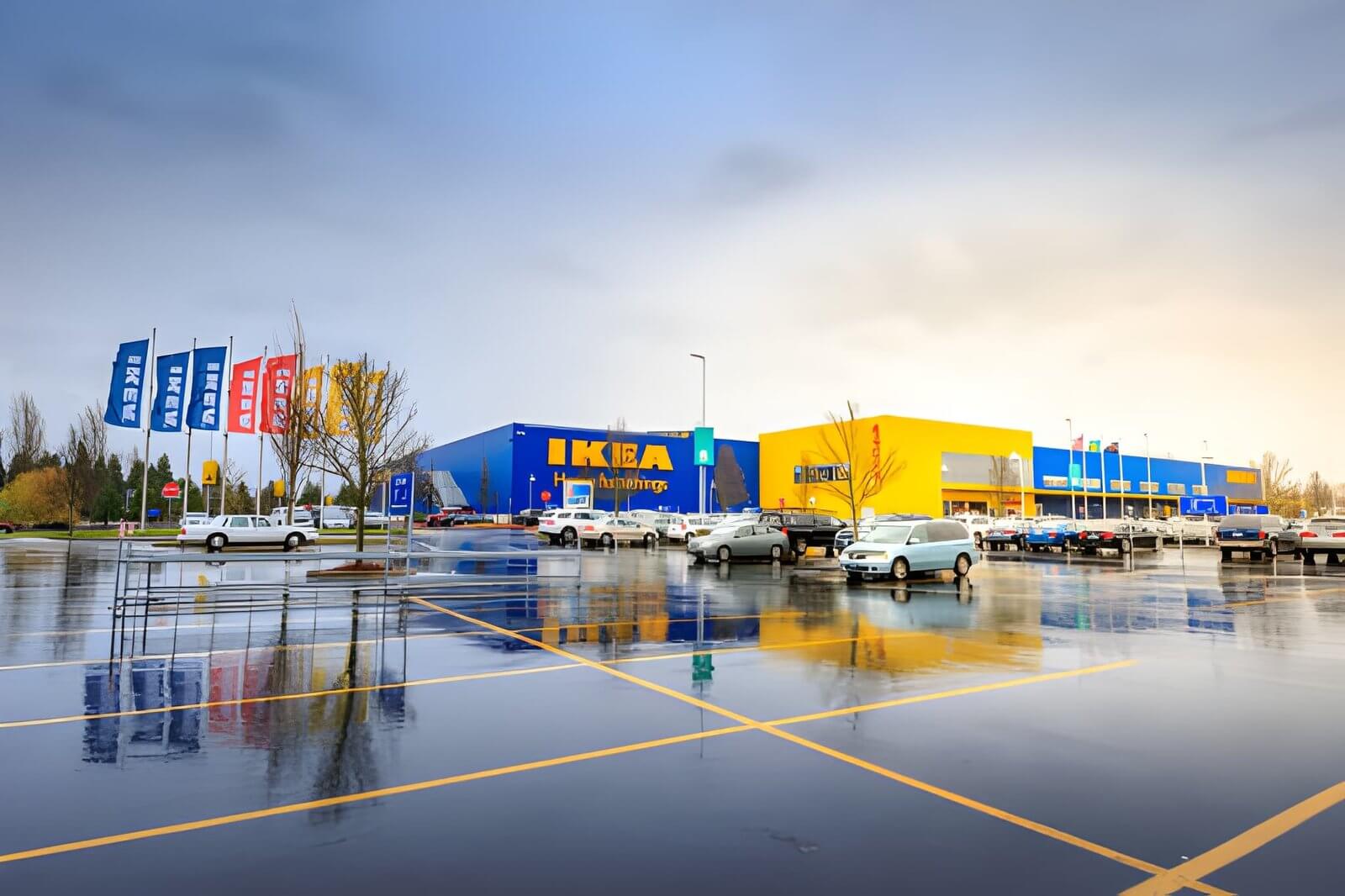
1. IKEA Family Turns Anonymous Shoppers Into Known Customers
Furniture retail has a customer identification problem.
Someone can enter a store, purchase a lamp, pay, and leave without creating a relationship that the retailer can continue.
The retailer knows that a product was sold, but it may not know who purchased it, what room the product was intended for, whether the customer was satisfied, or what the person might need next.
IKEA Family changes this.
Membership is free, which reduces the resistance customers may feel about registering. Members can present their digital card in the app, sign into their account online, or identify themselves during eligible transactions.
Once a customer uses an account, IKEA can begin connecting interactions to an identifiable profile.
Depending on the market and the customer’s permissions, these interactions may include purchases, saved products, wish lists, rewards, designs, event attendance, communication preferences, and online activity.
The customer receives benefits such as member prices, delivery savings, birthday offers, free drinks, price protection, workshops, and selected rewards.
IKEA receives a clearer understanding of the relationship.
This is why IKEA Family is more than a discount club.
It is IKEA’s customer identity engine.
The same principle appears in Nike’s membership model. Our Nike CRM case study explains how free accounts help Nike connect shopping, exercise activity, applications, and personalized experiences.
Businesses planning a similar program can also explore our guide to the best CRM for membership organisations.
2. IKEA Rewards Engagement, Not Only Spending
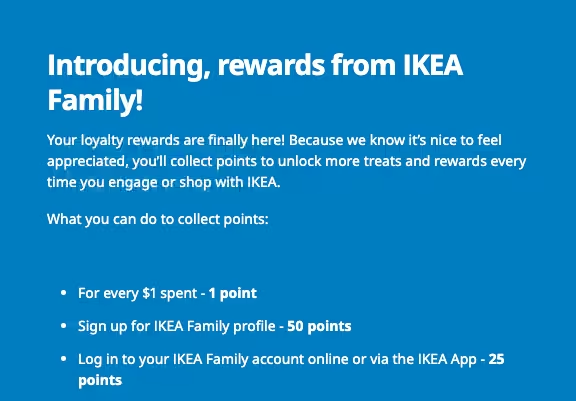
Traditional loyalty programs usually reward customers after they spend money.
The new Rewards from IKEA Family model goes further.
In the United States, members collect one point for every eligible dollar spent. However, they can also earn points by creating a profile, logging into their account, saving a wish list, or completing a design with IKEA Kreativ or the Kitchen Planner.
This approach is significant because furniture purchases are not as frequent as coffee, groceries, or cosmetics.
A customer may buy a sofa once and keep it for several years. IKEA therefore needs ways to maintain the relationship between major purchases.
Rewarding digital engagement gives the company more opportunities to do that.
A saved wish list indicates interest.
A kitchen design suggests a future project.
A return visit to the app creates another opportunity to provide inspiration.
Participation in a workshop shows that the customer is interested in learning, even when no immediate purchase occurs.
The customer benefits because useful activities can lead to practical rewards.
IKEA benefits because the program encourages people to remain active inside its digital ecosystem.
Starbucks also combines membership, mobile activity, rewards, and personalized communication. Our Starbucks CRM strategy examines how these elements can increase engagement and repeat purchases.
3. The IKEA App Connects Digital and Physical Shopping
Many customers no longer complete an entire purchase journey through one channel.
Someone may discover a room idea online, save several products inside the app, check whether the items are available, visit a store, scan products while shopping, and arrange delivery from a phone.
The IKEA app is designed to support this movement between channels.
Its features include wish lists, stock notifications, a three dimensional product visualiser, purchase tools, a digital IKEA Family card, Scan and Pack, store planning, and access to IKEA Kreativ.
Scan and Pack allows customers to scan products as they move through a store, making the checkout process more convenient.
Wish lists allow people to organize products before visiting.
Stock notifications reduce the frustration of travelling to a store for an unavailable item.
The digital IKEA Family card helps the company connect in store purchases to the same member identity used online.
In financial year 2024, the IKEA app was downloaded 18.9 million times, recorded more than 273 million visits, and generated about 12 percent of online sales.
These numbers show that the app is not simply a digital catalogue.
It has become a transaction and relationship channel.
Walmart applies a similar omnichannel principle by connecting stores, ecommerce, mobile tools, payments, delivery, and customer accounts. You can read more in our Walmart CRM strategy.
4. IKEA Kreativ Reduces Uncertainty Before a Purchase
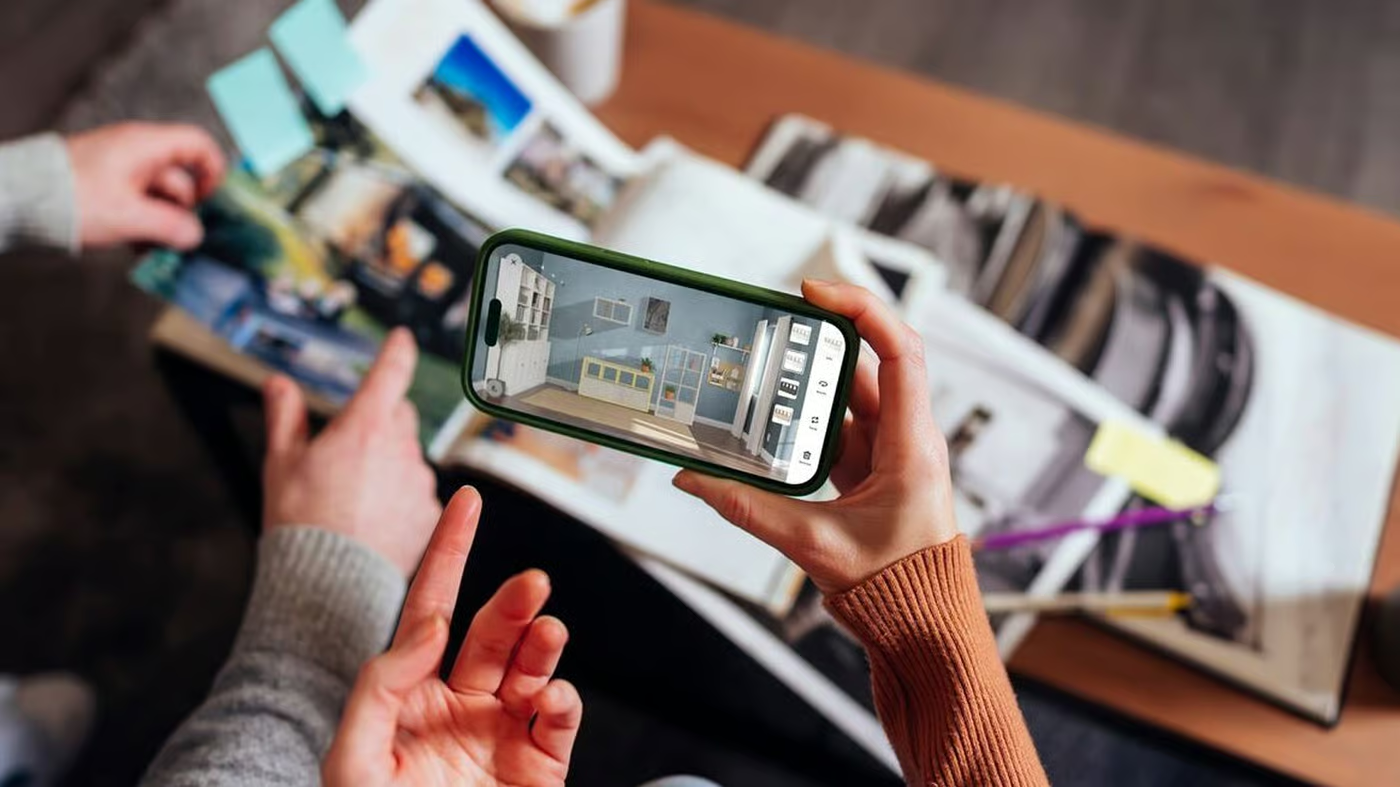
Furniture purchases contain more uncertainty than many everyday transactions.
Customers need to know whether an item will fit, match their existing furniture, provide enough storage, and look appropriate inside the room.
Product photographs cannot always answer those questions.
IKEA Kreativ addresses this problem by allowing customers to create a digital version of their own spaces.
Customers can scan a room using the IKEA app. The technology produces an interactive image that allows them to remove existing furniture and position IKEA products inside the space.
They can move products, rotate them, compare alternatives, save the design, share it with other people, and add products to a shopping cart.
This benefits customers because they can make decisions with more confidence.
It benefits IKEA because customers who understand how products will look and fit may be more comfortable proceeding with a purchase.
The planning activity can also generate valuable intent signals.
A person who designs a kitchen is probably closer to a major purchase than someone who briefly visits a product page.
IKEA recognized this behaviour when it included saved IKEA Kreativ and Kitchen Planner designs among the activities that can earn loyalty points in the United States.
IKEA Kreativ had more than 2.9 million active users across 29 countries in financial year 2024. By December 2024, IKEA reported that the platform was helping more than seven million active designers each year.
The company has continued expanding its planning tools. Its newer three dimensional kitchen planning experience supports approximately 1.75 million design projects each year.
Interior design businesses trying to provide a similarly organized customer journey can compare platforms in our guide to the best CRM software for interior designers.
5. Billie Automates Routine Support Without Removing Human Help
Customer service teams regularly receive questions about orders, product availability, delivery, returns, and store information.
Many of these questions are repetitive.
IKEA introduced Billie to handle common enquiries through artificial intelligence and natural language processing.
Between 2021 and 2023, Billie resolved approximately 47 percent of the customer enquiries it received. This represented about 3.2 million interactions and nearly €13 million in reported savings.
The obvious benefit is efficiency.
A chatbot can operate continuously, handle several conversations at once, and give customers immediate answers to routine questions.
However, IKEA’s implementation contains a more valuable CRM lesson.
Instead of treating automation only as a way to reduce customer service work, IKEA retrained approximately 8,500 call centre employees for activities such as remote interior design, digital retail sales, relationship building, and complex problem solving.
This created a division of responsibility.
Billie handles predictable questions.
Human employees handle situations where customers need expertise, reassurance, creativity, or judgement.
Remote customer meeting points generated €1.3 billion in sales during financial year 2022, representing 3.3 percent of Ingka Group sales at the time.
The strategy demonstrates that automation and personal service do not have to compete.
Automation can remove simple work so employees have more time for valuable conversations.
Results of IKEA’s CRM Strategy
More Than 200 Million IKEA Family Members
IKEA Family passed 200 million members in 2026.
The program operates across 31 Ingka Group countries and continues to add approximately 1,800 members every hour.
This gives IKEA a large pool of direct customer relationships.
Instead of depending entirely on advertising platforms to reach previous shoppers, IKEA can communicate through member accounts, email, its application, stores, and loyalty channels.
More Than 24 Million Members in the United States
IKEA Family launched in the United States in 2011.
By May 2025, it had more than 24 million American members.
The program continued evolving with the introduction of points for purchases, app activity, saved lists, profile creation, and digital planning.
Stronger Spending Among Members
IKEA Australia reported in 2025 that IKEA Family members spend more than three times as much annually as customers who are not members.
This does not prove that membership alone causes the additional spending. People who already like IKEA may also be more likely to join the program.
However, the difference shows that IKEA Family successfully attracts and identifies some of the company’s most engaged customers.
273 Million App Visits
The IKEA app recorded more than 273 million visits and 18.9 million downloads during financial year 2024.
It also accounted for approximately 12 percent of IKEA’s online sales.
This demonstrates that customers are using the app for more than occasional inspiration.
It has become an important part of the buying journey.
30 Percent of Sales Through Online Channels
Ingka Group reported that online channels accounted for 30 percent of IKEA retail sales in financial year 2025, up from 28 percent in the previous year.
The increase reflects the growing importance of ecommerce, mobile tools, digital planning, and connected fulfilment options.
Four Billion Online Visits
IKEA recorded approximately four billion online visits in financial year 2025, alongside more than 730 million visits to physical retail locations.
These figures explain why IKEA needs an omnichannel CRM strategy.
Customers are interacting with the company at enormous scale through both digital and physical touchpoints.
Higher Customer Satisfaction
Ingka Group’s Happy Customer Score increased from 80 in financial year 2023 to 84 in financial year 2024.
The company described the score as its main customer experience measure, combining feedback from several sources.
Technology cannot take full credit for the improvement. Prices, stock availability, delivery, product quality, and store experiences also influence satisfaction.
However, IKEA reported that its investments in digital experiences and artificial intelligence contributed to a record customer score.
What Businesses Can Learn From IKEA’s CRM Strategy
1. Make Membership Easy to Join
IKEA Family is free.
Customers do not need to reach a spending threshold before receiving recognition. They can join immediately and begin receiving relevant benefits.
Your membership or loyalty program should also have a clear and simple entry point.
Complicated registration processes reduce participation before the relationship begins.
2. Provide Immediate Value
IKEA Family offers benefits that customers can understand.
Depending on the market, these may include special prices, delivery savings, drinks, events, birthday rewards, and price protection.
The benefits are connected to real customer concerns.
Customers want to save money, reduce delivery costs, learn how to improve their homes, and feel recognized.
A loyalty program becomes more attractive when the value is useful rather than decorative.
3. Remove Uncertainty Before Asking for Payment
IKEA Kreativ helps customers see products inside their homes before buying them.
This addresses one of the biggest reasons people delay furniture purchases.
Think about the uncertainty surrounding your own product or service.
Customers may need a sample, demonstration, assessment, consultation, comparison, estimate, trial, or visual preview.
Good CRM should help identify where people become uncertain and provide the information needed to continue.
4. Listen Beyond Sales Data
Purchase records show what customers bought.
They do not always explain why.
IKEA combines transaction data with surveys, home visits, interviews, support feedback, and cultural research.
Your business can do the same on a smaller scale.
Ask customers what they were trying to achieve, what nearly prevented the purchase, what disappointed them, and what would make the experience easier next time.
The answers may reveal opportunities that a sales report cannot show.
5. Build a CRM Around the Customer Journey
IKEA’s customer journey may begin with inspiration and continue through planning, purchasing, delivery, assembly, support, resale, and another home project.
The company’s tools reflect these different stages.
Your CRM should also match how customers actually buy.
Do not copy another organization’s fields and workflows without understanding whether they fit your business.
For companies starting from the beginning, our guide to CRM for small business owners explains how to select a system according to business needs, budget, accessibility, and growth plans.
Conclusions
The IKEA CRM case study demonstrates that strong customer relationships can be built even in an industry where major purchases happen infrequently.
The strongest lesson is that IKEA does not treat CRM as a tool for sending more promotions.
It uses CRM to help customers solve the practical and emotional problems connected to creating a home.
Your company may not need augmented reality, a global research program, or an artificial intelligence chatbot.
However, it can still apply IKEA’s central principle.
Understand what the customer is trying to achieve. Remove the obstacles in their journey. Remember the relationship. Then provide a useful reason to return.
That is how a furniture membership program became a 200 million member community.
Frequently Asked Questions
IKEA does not publicly identify one companywide CRM product that manages every market.
Its customer relationship ecosystem includes IKEA Family, the IKEA app, ecommerce accounts, IKEA Kreativ, planning tools, customer research, remote selling, physical stores, and its Billie customer service chatbot.
There is no reliable public confirmation that Salesforce serves as IKEA’s unified global CRM.
Individual teams or markets may use different enterprise platforms, but IKEA’s public materials focus on its proprietary loyalty, planning, customer service, and digital experience tools.
IKEA’s CRM strategy centres on identifying customers through IKEA Family, connecting digital and physical shopping, personalizing member communication, reducing purchase uncertainty, studying life at home, and using automation to improve customer support.
IKEA can collect customer information through membership registration, identified purchases, website activity, application usage, wish lists, saved designs, event participation, customer support, surveys, and voluntary research.
The exact information collected depends on the market, service, privacy rules, and customer permissions.
IKEA Family is successful because it is free, accessible, and connected to benefits customers can use.
It combines member pricing, rewards, events, inspiration, restaurant benefits, digital tools, delivery savings, and personalized communication.
Small businesses can learn to make membership easy, offer immediate value, reward meaningful engagement, connect customer channels, gather qualitative feedback, and use automation without removing access to human support.