Airbnb was born in 2007 when two roommates in San Francisco, Brian and Joe, were trying to figure out how to pay their rent. They later learnt that a design conference was coming to San Francisco and hotels were sold out, so they inflated three airbeds and turned their apartment into an Airbed & Breakfast. They hosted three guests — Michael, Kat, and Amol — and in doing so, they became the first hosts on Airbnb. The connections Joe and Brian made that weekend led them to realize, “Maybe there’s a bigger idea here!” Soon after, Nate later joined them.
Since its founding, Airbnb has grown to become one of the largest hospitality companies in the world. Airbnb has hosted over 1 billion guests worldwide. The company has a market capitalization of around $100 billion and employs over 25,000 people worldwide.
The company’s success is from its marketing process; it focused mainly on educating the world about hosted travel.
They created a series of films using actual photographs of their customers on authentic trips staying in the homes of Airbnb Hosts worldwide. The purpose of these films is to let the world understand the magical experience that Airbnb hosts offer to their guests.
This case study examines Airbnb’s CRM strategy, the tools and processes behind it, and the key lessons businesses can apply when managing large, multi-sided customer ecosystems.
“Airbnb was never meant to be the big idea. It was meant to be the thing that paid the rent so we could think of the big idea.”
– Brian Chesky
The Best Overall

Pipedrive
A sales-focused CRM that leverages AI to automate sales, lead & demand generation.
Best Budget Choice

Freshsales
Freshsales automates your sales process, and helps drives sustainable business growth.
Best for Workflows

Zendesk
Customize your workflows to track all aspects of the sales cycle, from lead gen to post-sale support.
Airbnb Timeline
Brian and Joe host Airbed & Breakfast's first guests
Airbed & Breakfast officially launches during SXSW. Two bookings!
The Airbed & Breakfast website launches in time for the Democratic National Convention and gets 80 bookings.
Airbnb launched Payments, a bespoke payments platform which in 2019 processed about $70 billion in guest and Host transactions in over 40 currencies
Tesla raises $40 million in debt financing
They officially changed their name from Airbed & Breakfast to Airbnb and expanded beyond rooms to offer apartments, whole homes, and vacation rentals.
Airbnb launched their app and Instant Book feature
They begin their international expansion with the opening of our German office.
They introduce their $1M Host Guarantee
In response to Hurricane Sandy, they partnered with New York City to house displaced residents and launch their Disaster Relief Tool.
Airbnb opened their 888 Brannan Street HQ, a few blocks from our first listing on Rausch Street.
They introduce their new logo, the Belo
Airbnb became the official alternative accommodations provider for the 2016 Rio Games.
Airbnb launches in Cuba
Announcement of their nine-year partnership with the International Olympic Committee
They became a publicly traded company and rang the bell with Hosts worldwide who make Airbnb.
Airbnb announced the launch of Airbnb.org, a non-profit that connects people to places to stay in times of crisis.
Airbnb announced the Airbnb 2021 Release: 100+ upgrades to their service and product to make travelling and hosting easier.
Airbnb announced the 2022 Summer Release: the most significant change to Airbnb in a decade, featuring Airbnb Categories, Split Stays and AirCover for guests.
Airbnb introduced Airbnb Setup, a new, easy way for millions of people to host on Airbnb. They also announced they provide even more AirCover for Hosts and added six new Airbnb Categories.
Challenges Airbnb Faces in 2026
Regulatory Crackdowns in Major Cities
In 2025, Airbnb continues to face strict short-term rental regulations in major cities. One of the most impactful examples is New York City’s Local Law 18, which requires host registration and on-site host presence. After full enforcement, active Airbnb listings in New York City reportedly declined from approximately 22,000 to about 2,300, significantly reducing supply in one of Airbnb’s largest urban markets.
Large-Scale Fines for Non-Compliant Listings
European regulators have increased enforcement against short-term rental platforms. In late 2024 and continuing into 2025, Spain’s Ministry of Consumer Affairs imposed a €64 million fine on Airbnb for advertising tens of thousands of tourist rentals that lacked valid licenses, one of the largest penalties ever issued against the platform in Europe.
Reduction in Short-Term Rental Supply in Tourist Regions
Spain’s broader crackdown on short-term rentals has led to a sharp decline in available listings in high-tourism areas. In Ibiza, official reporting shows that the number of legal holiday rentals fell by nearly 50% following tighter enforcement and license withdrawals, directly affecting Airbnb’s inventory in the region.
Rising Public Opposition and Anti-Tourism Protests
Between 2024 and 2025, multiple Spanish cities experienced large-scale protests against overtourism, with residents citing housing shortages and rising rents. These protests have accelerated policy changes targeting platforms like Airbnb and limiting short-term rentals in city centers and residential neighborhoods.
Trust, Safety, and Legal Complaints
Trust is foundational to Airbnb’s business model, yet safety incidents remain a persistent challenge. Airbnb has acknowledged issues related to property damage, unauthorized parties, and guest safety concerns in its official Trust & Safety updates and SEC filings.
In response, Airbnb introduced identity verification, reservation screening, and its AirCover protection program. However, the company continues to report significant investment in trust and safety operations, indicating that risk mitigation remains an active and costly challenge.
Inconsistent Service Quality Across Hosts
Unlike traditional hotel chains, Airbnb does not control the physical quality of listings. Each property is managed by an independent host, leading to variability in cleanliness, amenities, and service standards.
Airbnb has publicly acknowledged this challenge in shareholder communications, emphasizing ongoing investments in host education, review systems, and quality enforcement tools.
Housing Affordability Pressure
Airbnb has faced criticism from city governments and housing authorities over its impact on housing availability and rental prices. This issue has been directly cited in policy documents and legislative debates used to justify stricter regulations.
Airbnb has publicly responded by promoting long-term stays, responsible hosting policies, and cooperation with governments, but the reputational challenge remains.
Airbnb CRM Case Study: Top Six CRM Strategies Fueling Their Growth
1. Airbnb Marketing Campaigns
- “Airbnb It” campaign: Airbnb company initiated this “Airbnb It” campaign to make people aware that they can be paid by becoming hosts of places they own but don’t occupy all the time. They used animation, a light tone, and playful visuals to show people that hosting on Airbnb is more approachable than they think. With this campaign, they became more interested in becoming hosts.
If you have a home you’re not always in, an empty bedroom, a camper you never use, or a guest house that you only sometimes use, then you can Airbnb it.
- “Made it possible by the host” Campaign: Instead of driving traffic to their site, they focused on educating the world about hosted travel and what makes Airbnb unique. With this campaign, they let people understand the magical experiences that Hosts offer their guests. They created a series of films using actual photographs of customers on authentic trips staying in the homes of Airbnb Hosts worldwide.
2. Airbnb Marketing Mix
Airbnb’s marketing mix aims to release a product with the right price and at the right place by using the right promotion tools. The fundamental values are well-detailed below;
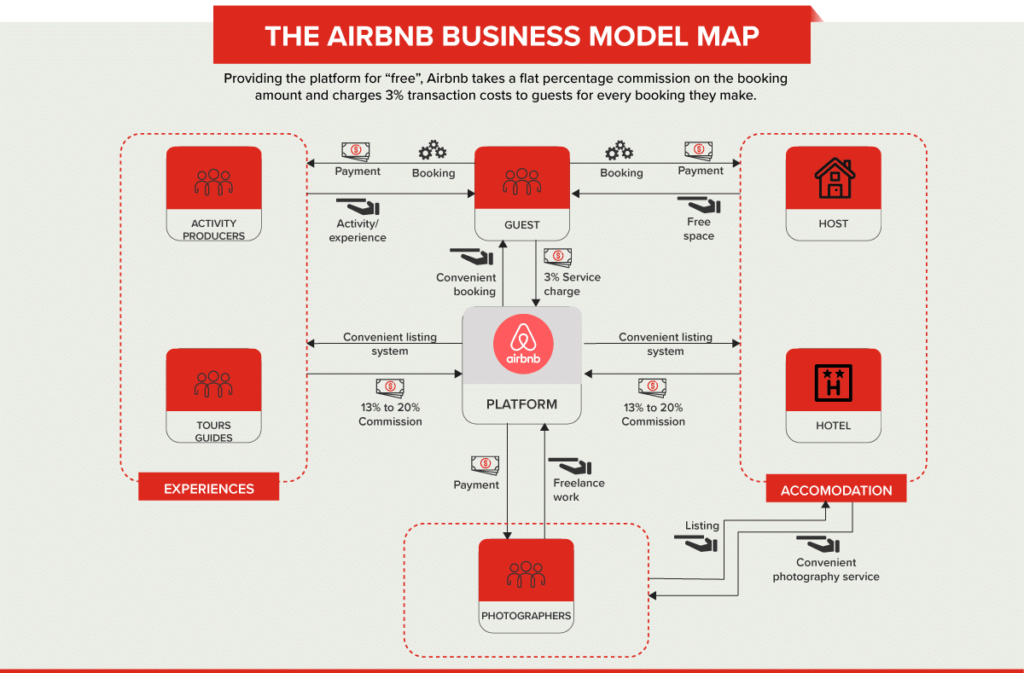
- Airbnb Product strategy: They created a simple website called “Airbed and Breakfast to connect renters with the host(who have spare space in their homes). It allows travelers to conveniently rent a room or an apartment through its mobile app or website.
This strategy is two-sided as they earn from the Airbnb host and the traveler. Also, they do
Airbnb’s website is designed to make registering very easy for travelers.
They worked perfectly on their UI to enable hosts to add important info such as acceptance of dogs, smoking, etc.
- Airbnb price strategy: they are widely known for providing relatively low-cost services compared to hotel companies. They set prices below the market average to undercut hotels to make their product stand out.
- Airbnb place strategy: Where a property is located plays a vital role in marketing. Airbnb understands that “no traveler would want to book a place out of the city.” No traveler would like to book a place far away from the Airport and not book a place where the conditions are not good. So, they were able to provide access to accommodations in more than 200 countries where travellers can find quality accommodations. This can be accessed through all digital platforms and thus has a substantial global reach.
- Airbnb Promotion strategy: Unlike other brands focusing on global marketing, Airbnb focuses on local marketing to promote its product. Airbnb effectively promotes its service to travelers through proper marketing segmentation, word of mouth, social media accounts, referral programs, etc.
3. Airbnb Content Marketing
Airbnb made the most of user-generated content by enticing visitors to document their travels through images and stories. During their visits, guests were encouraged to post photos and write notes highlighting their favorite parts.
On sites like Instagram, Twitter, and Facebook, They urged users to include the hashtag #Airbnb in any travel-related postings they made. This increases user engagement and produces a tonne of user-generated material.
Airbnb selected this information and posted it on its website and social media channels, evoking a sense of authenticity and a desire to travel.
4. Airbnb Influencer marketing
Airbnb collaborates with various influencers, including travel bloggers, celebrities, and social media personalities, tapping into their audience to promote the platform’s offerings and inspire travel enthusiasts around the globe.
Here, Influencers showcase their stays in Airbnb accommodations, highlighting the distinctive features and personalized experiences they encounter. They also curate captivating content, including travel guides and recommendations, that showcase each location’s unique attractions and experiences. This approach combines visual storytelling with practical advice to ignite curiosity and inspire travellers to consider Airbnb for their next adventure.
4. Airbnb referral program
This programme provides the community members with rewards for inviting new users to the platform. If you onboard a friend on Airbnb, you and your friend will receive a discount on your next booking.
This marketing tactic helps Airbnb expand its pool of consumers through existing users, reducing the high cost of customer acquisition.
What CRM software does Airbnb use?
Airbnb understands that as businesses grow, so does the need for efficient and effective customer communication. So, they depend heavily on Twilio CRM for its growth. Twilio CRM is a cloud communication platform that provides tools for building communication applications such as voice, video, SMS, and more.
With Twilio CRM, Airbnb can communicate with their customers from anywhere without needing a physical phone. Its automatic voicemail has enabled Airbnb’s customers to drop a message, ensuring that Airbnb stays up-to-date with all their needs and concerns.
Thanks to Twilio CRM, it has helped Airbnb to manage their customers’ communication straightforwardly.
What CRM software does Airbnb use?
Airbnb understands that as businesses grow, so does the need for efficient and effective customer communication. So, they depend heavily on Twilio CRM for its growth. Twilio CRM is a cloud communication platform that provides tools for building communication applications such as voice, video, SMS, and more.
With Twilio CRM, Airbnb can communicate with their customers from anywhere without needing a physical phone. Its automatic voicemail has enabled Airbnb’s customers to drop a message, ensuring that Airbnb stays up-to-date with all their needs and concerns.
Thanks to Twilio CRM, it has helped Airbnb to manage their customers’ communication straightforwardly.
Conclusion
To build a scalable business, it’s best to emulate the strategies used by top companies. Customer relationship management is the primary factor considered by significant companies. Airbnb is not excluded. They use Twilio CRM software to streamline their business processes.
Twilio CRM enables Airbnb to tap into customers’ behaviors and renting habits. From the customer’s side, they get a superior, more tailored service – and will be more likely to rent in Airbnb again.