




















A global team is often a clear signal of growth. Employer of Record (EOR) services make that growth possible by helping companies access international talent, enter new markets quickly, and expand without setting up local entities.
But choosing the right EOR is not about selecting the lowest number on a pricing page. It’s about securing predictable costs, strong compliance protection, and contractual terms that truly support your long-term expansion strategy.
Too often, businesses compare providers based only on headline monthly fees. That figure actually only reflects a small portion of the overall commitment. Your legal risk and financial exposure can be significantly impacted by contract duration, termination terms, indemnification clauses, statutory benefit requirements, and national labor laws.
Without carefully examining these terms, what appears affordable upfront can become costly over time. This article will show you how to systematically compare contract terms and pricing for EOR services, highlighting seven practical steps you can duplicate:
- Step 1: Identify Your Needs (Prep Phase)
- Step 2: Build a Shortlist of 3–5 EOR Providers
- Step 3: Ask for and Gather Comprehensive Quotes
- Step 4: Create a Spreadsheet Comparison Scorecard
- Step 5: Examine Contract Terms Side by Side
- Step 6: Test & Validate
- Step 7: Make a decision
If you are contemplating the use of an EOR for global hiring, this article will assist you in selecting a partner who will not hinder your international expansion and will help you avoid costly surprises.
What Is an EOR?
An Employee of Record (EOR) is a third-party organization that legally employs part-time or full-time workers on a company’s behalf in a foreign country. They handle all the complex country-specific employment responsibilities, managing payroll, taxes, benefits, and compliance with local labor laws.
Rather than establishing a local entity to manage new labor laws and processing payroll in a different jurisdiction, you partner with an EOR. On paper, the EOR becomes the employee’s legitimate employer; however, you still retain complete authority over their daily tasks. Take, for example, Deel, Multiplier, and Velocity Global.
How does an EOR work?
When employing someone via an EOR:
- The EOR executes the local employment agreement.
- Payroll is processed by the EOR using local currency.
- Statutory contributions and tax withholding are managed by the EOR.
- The EOR manages required benefits.
- The EOR makes sure that local labor laws are followed.
Meanwhile, your company:
- Manages performance
- Assigns responsibilities
- Decides on compensation
- Oversees the day-to-day activities
This structure significantly reduces setup time and administrative burden by enabling you to hire employees worldwide without establishing a legal entity overseas. An EOR agreement serves as a legal risk allocation document in addition to being a service contract. Therefore, it is essential to understand the functions of an EOR and the allocation of responsibilities before comparing contract terms and prices.
Functions of an EOR
This provides answers to the following questions:
- Who bears the responsibility for compliance?
- How disputes pertaining to employment are resolved?
- Who pays severance or accrued leave?
- What happens if labor laws change?
- How easily can you exit the agreement?
Understanding EOR Pricing and Contract Terms
It is important to understand the pricing structure of EOR providers before signing any contract. On the surface, EOR fees might seem straightforward and often appear as a simple monthly rate per employee. But the actual cost structure is hardly that simple. Companies may underestimate their long-term financial commitment if they do not carefully evaluate pricing models, which differ among providers, countries, and service scopes.
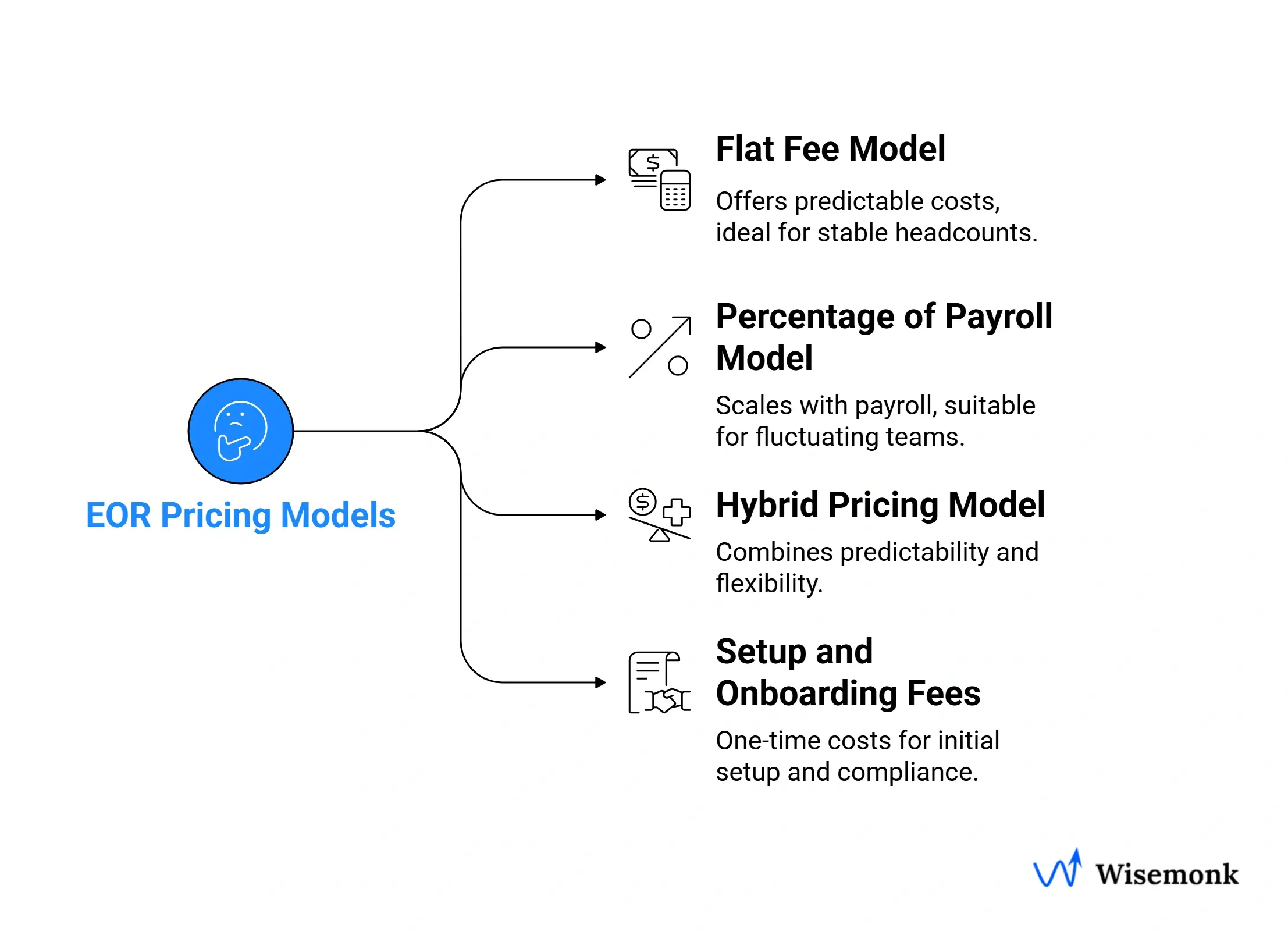
EOR Flat Monthly Fee
The flat monthly fee per employee is the most widely used pricing model. Under this arrangement, companies pay a set monthly sum for each employees, regardless of pay grade, who are hired through the EOR. This method provides predictability, which facilitates financial forecasting and budgeting.
Hiring mid-to-senior-level staff is especially advantageous because the cost stays the same even if salaries rise.
However, flat pricing does not always include every service. Some providers may charge additional fees for onboarding, immigration support, equity administration, or enhanced HR advisory services. As a result, the advertised flat fee may represent only part of the total expense.
Percentage of Payroll
The percentage of payroll structure is another popular model in which the EOR deducts a specific amount of the employee’s total salary, usually from 5% to 20%. The EOR fee goes up in relation to changes in compensation structures, bonuses, or salary increases. A flat-fee arrangement may not always be more cost-effective than percentage-based pricing for businesses employing senior or highly compensated professionals.
EOR Hybrid
Some providers use a hybrid model, which combines a base monthly fee with extra fees based on the services utilized. Volume-based discounts, bundled service tiers, and optional add-ons for specialized support are a few examples of this structure.
Hybrid pricing frequently decreases transparency even though it can provide flexibility. Accurately calculating the entire annual expense becomes challenging in the absence of a thorough breakdown of what is included and what incites additional charges.
Hidden Costs
The monthly price you see for EOR services usually isn’t the full cost. Many providers charge extra fees for things like onboarding new employees, processing terminations, handling currency conversions, managing mandatory benefits, supporting equity compensation, or adjusting prices annually.
Some countries may also come with additional compliance charges. While the base fee may look simple and predictable, these extra costs can add up quickly, especially if you’re hiring in multiple countries. To avoid surprises, always ask for a detailed monthly cost estimate that includes all possible fees so you understand the true total cost before signing the contract.
Comparison Table: EOR Pricing Models
| Pricing Models | Typical Cost Range | Best For | Pros | Cons |
|---|---|---|---|---|
| Flat Monthly Fee | Deel starting price $125–$899+ per employee/month | High-salary roles, predictable budgets, small/variable teams | Easy forecasting, no salary-scaling issues | Can feel high for low-wage hires |
| Percentage of Payroll | 5%–20% of gross salary | Lower-wage markets, scaling with compensation | Aligns with payroll size, lower for juniors | Volatile with raises/bonuses, expensive for execs |
| Hybrid | Varies (base + add-ons or negotiated) | Large/enterprise teams, complex needs | Flexible, potential discounts | Less transparent, requires deep quotes |
Critical EOR Contract Terms to Compare
The actual risk in an EOR agreement is found in the terms of the contract, particularly in the way that your company and the EOR provider assigned responsibilities and liabilities.
The contract you sign establishes who bears financial and legal risk in the event that something goes wrong, since the EOR becomes the legal employer on paper. The most important clauses to pay close attention to are these:
Legal Employer Responsibility
Although the EOR is the official legal employer, not all agreements allocate responsibilities equally. The contract should specify exactly what the EOR is in charge of, including payroll processing, tax filings, statutory benefits, employment contracts, and daily compliance obligations with local labor laws.
Any ambiguity in this section can lead to confusion regarding accountability, particularly during disputes or regulatory audits.
Liability & indemnification
This is among the most crucial parts of the agreement. If there are violations of employment laws, miscalculated taxes, payroll errors, compliance errors, tax audits, misclassification claims, employee lawsuits, or disputes, liability clauses specify who is financially responsible.
Some EOR agreements limit the provider’s liability or shift certain risks back to your company. Examine the indemnity language carefully to determine whether the EOR actually takes on compliance risk or merely makes administrative work easier.
Compliance obligations
It should be clearly stated in the EOR contract that the provider will guarantee compliance with statutory benefits, tax obligations, and local labor laws. Additionally, it should make clear how labor law updates are managed. Does the EOR automatically apply updates in the event that local regulations change, or are there additional fees?
Termination & Exit Terms
A clear exit agreement protects you from unforeseen financial exposure in the event that business priorities change. It can be more complicated to exit an EOR agreement than to enter into one. Examine notice periods, early termination penalties, and obligations pertaining to severance, accrued leave, and final payroll.
Compare Critical EOR Contract Terms (Checklist Table)
| Contract Terms | What to Look For | Red Flags | Why It Matters & Priority |
|---|---|---|---|
| Legal Employer Responsibility | EOR is clearly the legal employer + owns local entities | Vague facilitation or heavy partner reliance | Core of the model – High |
| Liability & Indemnification | Strong EOR indemnification for their errors/compliance; mutual where fair | One-sided, low caps, exclusions for fines/taxes | Who pays if audited? – Critical |
| Compliance Obligations | Proactive law updates, monitoring, audit rights | Best efforts only, no guarantees | Laws change fast – High |
| Data Protection & IP | GDPR-compliant DPA, full IP assignment to you | Missing DPA, weak IP clauses | Protects your data/code – Critical (tech) |
| Contract Length/Renewal | Flexible (monthly/short), easy opt-out | 12–24+ month lock-ins, auto-renew traps | Avoid being stuck – Medium |
| Termination & Exit | 30–60 days notice, low/no fees, smooth employee transition | High penalties, restrictive non-solicit | Easy to leave or pivot – High |
| Insurance Coverage | Proof of E&O, cyber, employment liability insurance | Minimal/undisclosed | Backup for claims – Medium-High |
Steps in Comparing Contract Terms and Pricing for EOR Services
In 2026, providers differ greatly in terms of fees, inclusions, and contract strength due to the rapidly expanding EOR market, which is estimated to exceed USD 9800.8 Million by 2034, with a CAGR of 6.8%, according to Market Growth Reports.
However, you can use these practical steps to compare contract terms and pricing for EOR services with confidence and objectivity.
Step 1: Identify Your Needs (Prep Phase)
Make sure your internal requirements are clear before contacting providers. This prevents misaligned proposals and inaccurate pricing.
Define:
- Target countries
- The number of current and anticipated hires
- Salary ranges
- Type of employment (executive hire, contractor conversion, full-time)
Step 2: Build a Shortlist of 3–5 EOR Providers
Research and identify providers that:
- Operate in the countries you have chosen.
- Possess knowledge of your field
- Exhibit proficiency in compliance
- Possess positive customer reviews
- Provide direct ownership of the entity (if desired).
Step 3: Ask for and Gather Comprehensive Quotes
Provide the same standardized information about your hiring plans to every provider that made the shortlist.
Request:
- Complete fee breakdown, not just the monthly amount
- An explanation of the pricing model (flat, percentage, hybrid)
- Fees for setup and off-boarding
- Markups on currency exchanges
- Terms of annual price increases
Step 4: Create a Spreadsheet Comparison Scorecard
Make a well-organized spreadsheet to compare providers impartially. For example:
Step 5: Examine Contract Terms Side by Side
This is where actual risk is determined. Examine contracts from:
- Legal employer responsibility
- Liability and indemnification clauses
- Obligations regarding compliance
- Notice periods for terminations
- Early exit penalties
- Clauses pertaining to IP and data protection
Step 6: Test & Validate
Before deciding on a course of action, confirm your assumptions:
- Seek references from similar jurisdictions.
- Test the responsiveness of onboarding
- clarify unclear contract language.
- Verify the insurance documentation.
Note that selecting an operational partner is more than just purchasing a contract.
Step 7: Make a decision
After scoring is complete:
- Internally, talk about trade-offs.
- Record the reasoning behind the decision.
- Discuss the final terms of the contract.
- Verify the final cost estimates in writing.
By putting your decision in writing, you guarantee accountability and give yourself a clear reference in case you have any questions later. This is the process summary in which the EOR contract terms and pricing can be compared practically:
Final Thoughts
Comparing EOR service contract terms and prices involves more than just looking at monthly costs; it involves a strategic assessment of risk, cost, and compliance. Although headline pricing may seem simple, liability allocation, termination flexibility, compliance infrastructure, and hidden fees are frequently where providers differ most.
Instead of responding to marketing claims, a systematic approach that includes defining your hiring needs, standardizing quotes, and comparing contract clauses side by side guarantees that you are making an informed, unbiased choice.
In the end, the best EOR partner isn’t always the cheapest; rather, it’s the one who offers consistent pricing, robust legal protection, and scalability in line with your expansion goals.
You can choose a provider with confidence that reduces long-term risk and promotes sustainable global expansion by using a comparison framework and thoroughly verifying contract terms.
Frequently Asked Questions
The ideal EOR is the one that suits your particular expansion plan. Give onboarding effectiveness top priority if hiring quickly is essential. Make insurance coverage and compliance depth your top priorities if you are entering highly regulated markets. Pay more attention to total cost of ownership than headline pricing if cost control is crucial. You can use a structured comparison framework to find the provider that best fits your legal, financial, and operational priorities.
The best EOR agreement is one that clearly defines legal employer responsibility, limiting your liability exposure, outlines compliance obligations, offering transparent pricing (including escalation clauses), and including reasonable termination and exit terms. Strong agreements reduce uncertainty, distribute risk equitably, and guarantee predictable long-term expenses across jurisdictions.
The best option depends on your hiring locations, risk tolerance, contract flexibility requirements, and total monthly cost projection. Providers like Deel, Multiplier, and Velocity Global all offer competitive worldwide coverage. Not just the lowest monthly fee, but also transparent pricing, robust compliance infrastructure in your target countries, balanced liability terms, and scalability in line with your growth plans are what make the best provider for you.