
Today, credit unions handle member communications via call centres, email, branches, and digital platforms. When these systems don’t connect, staff cannot see past conversations. This forces members to repeat information and disrupts service.
To create a better and more tailored experience, organizations now use a CRM for credit unions in 2026. This will help centralize member data and build lasting relationships.
According to industry surveys, 40% of U.S. credit unions have already implemented a CRM system, with another 30% planning to adopt one. CRM software has become essential for unified member management and engagement.
By the end, you will know exactly which CRM deserves a spot in your credit union.
What is a CRM for a credit union?
Credit union CRM is software made for member-owned, community-focused, not-for-profit financial institutions. It helps them manage member data, interactions, and relationships in one central system.
A CRM helps credit unions organize member profiles and track interactions. It works across branches and digital channels. This allows for personalized financial communication. As a result, credit unions can shift from transactional, account-focused engagement to need-based, member-focused relationships.
Why CRM Matters for Credit Unions in 2026
- Centralized Management of Member Data
In 2026, credit unions will centralize member data on a secure platform. With this, staff can access member profiles, interaction history, service requests, and financial relationships in real-time. This gives them a complete view of each member.
- Enhanced Engagement and Member Experience
Employees at credit unions can monitor member interactions through call centres, branches, and online platforms by using a CRM. In the omnichannel world of 2026, this integrated view facilitates quicker responses, lessens recurring questions, and raises overall member engagement.
- Tailored Financial Communications
Credit union CRMs allow for customized communication according to member needs, behavior, and life events. This makes it possible for credit unions to provide prompt follow-ups and more pertinent product recommendations, strengthening long-term partnerships.
- Improved Loan and Service Workflow Administration
Through automated workflows, a credit union’s CRM system facilitates the management of loan inquiries, applications, and service requests. This increases productivity, minimizes manual labor, and guarantees uniform follow-through among lending and service teams.
- Enhanced Productivity
Top CRM for credit unions enhances teamwork and internal efficiency by automating repetitive tasks like data entry, follow-ups, and reporting, freeing up employees to concentrate on higher-value member service.
- Greater Loyalty and Retention of Members
Credit union CRM software facilitates early identification of inactive or at-risk members by providing improved visibility into member activity and engagement. Proactive outreach increases long-term member value and retention.
- Strengthened Data Security and Compliance
Through secure data processing, role-based access, and audit trails, modern credit union CRMs satisfy regulatory requirements, assisting organizations in meeting compliance standards while safeguarding sensitive member data.
Key Features to Look for in Credit Union CRM Software
Management of Members
Credit union CRMs should offer a comprehensive, unified member profile that integrates engagement data, interaction logs, and account history. This enables more individualized financial product suggestions based on member requirements and behaviour and provides staff with a clear, 360-degree perspective of each member.
Processing of Loans and Mortgages
Since lending is crucial to credit union operations, the CRM system should make loan inquiries, applications, approvals, and renewals easier. Automated follow-ups and reminders help reduce delays, while integration with credit scoring and risk assessment systems enables speedier, more informed loan decisions.
Analytics and Financial Reporting
Reporting systems that monitor loan activity, member behavior, and service performance should be part of a credit union CRM. These insights improve risk monitoring and regulatory compliance while assisting leadership in making data-driven decisions.
Automation of Marketing
CRM marketing solutions enable targeted email campaigns, customized product recommendations, and digital interaction tracking. This increases member participation and enables credit unions to assess the effectiveness of their outreach programs.
5. Security and Compliance
CRM software for credit unions must support audit trails, role-based access controls, and data encryption. These features help credit unions protect sensitive member data while adhering to regulatory and compliance requirements.
Best CRM software for a Credit Union
1. HubSpot CRM: Overall Best for Credit Union

HubSpot is a well-known CRM system designed for teams in charge of sales, marketing, and customer support that require visibility throughout the whole customer lifecycle. HubSpot CRM is a versatile and simple solution for credit unions seeking to increase member engagement and simplify relationship management.
Teams can work together more easily and provide consistent member experiences thanks to the platform’s centralization of contacts, marketing campaigns, sales activities, and service interactions.
Credit unions may monitor members’ initial inquiries, onboarding, and continued involvement with HubSpot CRM. With its support for digital marketing initiatives, sales pipelines, contact and lead management, and communication history, the system provides employees with a comprehensive overview of all correspondence, meetings, and campaigns.
Features of HubSpot CRM
Contact & Company Management
HubSpot CRM provides a centralized system for managing contacts and organizations in one place. For credit unions, this means creating detailed member profiles that store contact information, communication history, engagement activity, and notes from staff interactions.
Each member profile is automatically updated as interactions occur—emails sent, forms filled, meetings booked, or calls logged. This allows branch staff, marketing teams, and service agents to access the same up-to-date member information, reducing duplication and improving service consistency.
Email Marketing Automation
Credit unions can create, plan, and automate customized email campaigns with this feature without depending on technical teams. Financial firms can use member information and behavior to send targeted communications, such as:
Follow-ups on loans Emails for product education
Sequences for member onboarding
Campaigns for engagement and retention
Automation guarantees the timely delivery of messages, increasing relevance and engagement while decreasing manual labour.
Sales Pipeline Dashboards
The sales pipeline dashboard in HubSpot gives credit unions a visual overview of how leads and opportunities move through different stages from inquiry to conversion.
For lending or member acquisition teams, this helps track:
Loan inquiries and applications
Referral progress
Follow-ups and approvals
Conversion performance
3. Integration with Marketing and Service Hubs
One of HubSpot’s strengths is its seamless integration across its Marketing Hub, Sales Hub, and Service Hub. This enables credit unions to oversee the entire member lifecycle from initial contact to continuing assistance within a networked ecosystem.
Marketing teams can run campaigns, sales teams can manage pipelines, and service teams can handle member inquiries, all while sharing the same member data. This alignment improves internal collaboration and delivers more unified member relationship management.
AI and Automation Tools
HubSpot CRM includes AI-powered and automation features that help credit unions work more efficiently and communicate more effectively.
Key AI capabilities include:
AI-enabled email templates that suggest subject lines and content
Automated task creation based on member activity
Smart follow-up reminders
Predictive insights to prioritize leads
These tools reduce repetitive work, improve response times, and help teams focus on higher-value member interactions.
| Pros of HubSpot | Cons of HubSpot |
|---|---|
| Free tier with essential CRM features | Advanced features require premium plans |
| Strong marketing automation for engaging members | Not built for complex enterprise financial processes |
| excellent ecosystem with 1,000+ integrations | Limited native ERP/financial system integration |
2. Zoho CRM: Best for Customizing
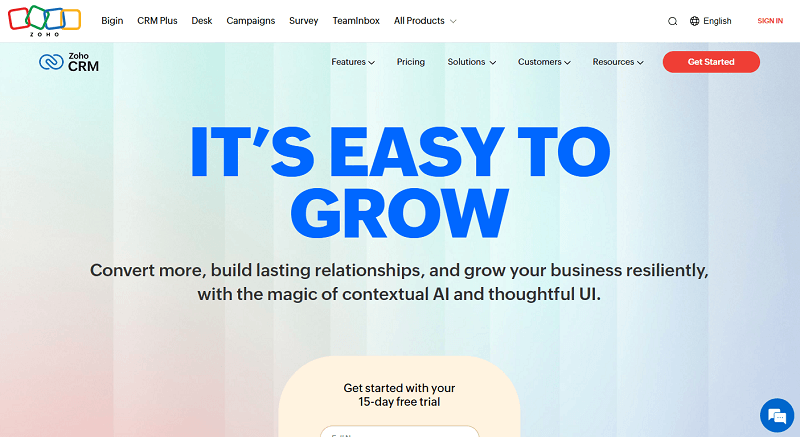
Zoho CRM is a cloud-based platform for managing customer relationships designed to help organizations streamline their sales, marketing, and customer engagement processes in one unified system. It gives teams deeper visibility into member interactions, automates routine tasks, and supports data-driven decision-making from a centralized dashboard.
However, Zoho CRM is part of the Zoho suite of business applications. It serves as a flexible, scalable CRM system for credit unions and other organizations that need to manage contacts, track engagement, automate workflows, and improve cross-team collaboration. It is accessible via web and mobile apps and integrates with many external applications to enhance functionality.
Features of Zoho
Lead and Opportunity Management
Zoho CRM enables credit unions to streamline the early stages of member acquisition through its lead and opportunity management capabilities.
Teams can identify and engage prospective members, guide them through the conversion process, and nurture those relationships over time to build long-term, recurring value. This structured approach helps credit unions move prospects smoothly from initial interest to active, loyal membership.
Flexible Data Model
Zoho CRM’s extremely flexible data model allows credit unions to arrange data according to different financial products and member relationships. Organizations are able to design their own loan management systems.
Automation Capabilities
This automation feature is reducing human work and enhancing operational efficiency. By using features like workflow rules, approval processes, and assignment rules, staff can standardize operations. This helps ensure consistency and allows them to focus on more important tasks.
Reporting and Analytics
Financial service firms can easily track service performance, confirm member information, and examine engagement trends with Zoho’s reporting and analytics tools. These insights help teams make better decisions, find high-quality leads, and continuously improve their outreach and service tactics.
Advanced Integration Capabilities
Through tools like Zoho Flow, institutions can connect their CRM with legacy banking systems to enable secure data exchange. Support for REST APIs and webhooks further enhances flexibility, making it easier to integrate with existing financial infrastructure.
Seamless Integration with External Tools
As part of the Zoho One ecosystem, Zoho CRM connects seamlessly with more than 40 additional applications.
This includes tools for marketing automation, appointment scheduling, digital signatures, document management, customer reviews, social media management, and contact center case management.
Together, these integrations support end-to-end digital transformation across marketing, operations, and member service.
| Pros of Zoho | Cons of Zoho |
|---|---|
| Free plan for three users | Limited free plan |
| All paid plans are affordable | Templates only for paid plan users |
| Easy to learn and use | Few third-party integrations |
3. Creatio CRM: Best for Member workflow
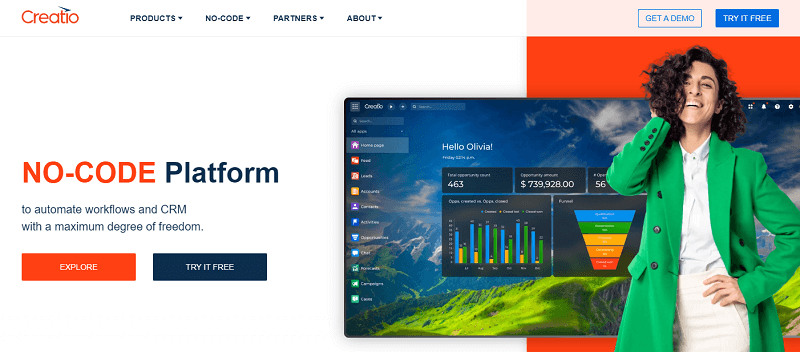
Creatio is a no-code, AI-powered CRM and workflow automation platform that aims to assist credit unions in modernizing operations and increasing member relationship management.
With built-in agentic, generative, and predictive AI, the platform enables teams to automate complicated processes, provide members with intelligent, human-like interactions, and boost productivity across sales, marketing, and service functions, all without relying heavily on IT.
Furthermore, it provides a wide range of out-of-the-box capabilities designed for core credit union activities such as lending, underwriting, compliance, verification, and member relationship management.
Its end-to-end automation enables credit unions to manage loan procedures, streamline onboarding, analyze risk, and satisfy regulatory criteria more effectively. As a result, credit unions can increase conversion rates, build member relationships, and compete in a highly regulated financial market.
Features of Creatio CRM
- Customer Management
Creatio enables your team to track and manage customer interactions and customer relationships efficiently. Its database consolidates all consumer data in one location, making access simple.
- Workflow Automation
To save time and errors, automate repetitive operations with automation tools, no-code, and low-code workflow builders. Create workflows that are tailored to your business operations and automation requirements.
- Lead Tracking
Easily acquire and track leads from a variety of data sources, such as web forms, email marketing, marketing campaigns, and social media. This enables your sales team to focus on turning prospects into clients.
- Reporting Tools
Create reports and dashboards to analyze your team’s performance using metrics and segmentation to make better educated decisions.
- Contact Management
Use the CRM platform to keep track of and update all of your contacts. This tool helps your team handle relationships more successfully.
| Pros of Creatio CRM | Cons of Creatio CRM |
|---|---|
| Automates complex workflows | Complex for smaller teams |
| No-code customization | Customization requires defined processes |
| Compliance-friendly capabilities | Steeper learning curve |
| View Automate sales process, routines, tasks, and appointments track your prospects from a single dashboard |
4. Pipedrive CRM: Best in Pipeline Visibility
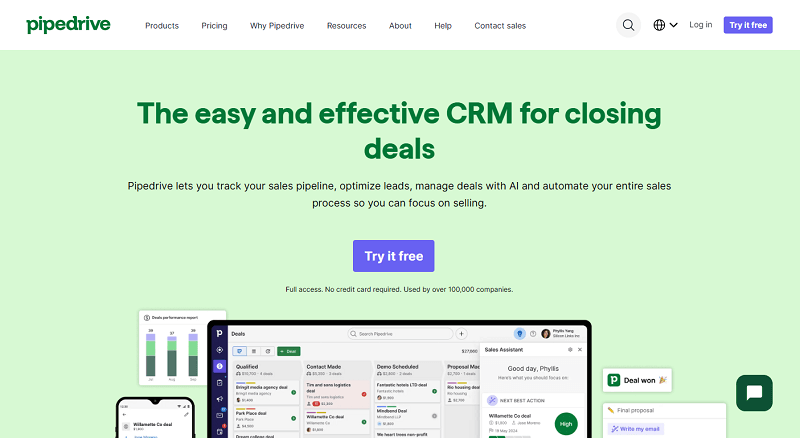
Pipedrive is a cloud-based CRM program that uses an activity-based workflow and visual sales funnel to streamline relationship and pipeline management.
While traditionally positioned as sales-oriented CRM software, many of its core capabilities are relevant to the needs of smaller or mid-sized financial institutions, including credit unions looking for a simple CRM that prioritizes member engagement, task tracking, and pipeline visibility.
Pipedrive allows credit unions to manage contacts, track member interactions, and arrange service or loan pipelines all in one location, making teams more organized and responsive.
Pipedrive, which focuses on ease of use, visual deal phases, and automation, provides basic workflow management and CRM operations without the complexity of enterprise-level systems.
Features of Pipedrive CRM
- Visual Pipeline Management
Pipedrive’s standout feature is its visual deal pipeline, which shows all member interactions and opportunities in stage-based cards. For a credit union, this visual workflow allows teams to readily track where each conversation, service request, lead, or loan inquiry is in the engagement process and what steps are required next.
- Contact and Interaction Tracking
Credit unions can consolidate and manage member contact information, communication history, and relationship status in a single spot, improving member visibility across branches and support teams.
- Activity and Task Automation
Pipedrive automates common operations such as reminders, follow-ups, and assignment scheduling, allowing credit union staff to keep on top of member engagements and service commitments without manual effort.
- Insight and Reporting
The CRM provides basic reporting dashboards that enable credit union teams to monitor pipeline health, measure performance metrics, and detect bottlenecks in member service operations.
- Integrations
A wide range of third-party applications, including calendars, messaging apps, email clients, and productivity apps, are integrated with Pipedrive. This makes it possible for credit unions to merge member interaction data from multiple sources without creating duplicate entries.
| Pros of PipedriveCRM | Cons of Pipedrive CRM |
|---|---|
| Scalable plans suitable for small and growing teams | Free plan is very restricted and mainly useful for trials |
| Mobile app for remote access and flexibility | Customization options are more |
| Visual sales pipeline for clear deal progress and forecasting | Less suitable for advanced marketing needs |
5. Sugar CRM: Best in Custom workflow
SugarCRM is a highly customizable and adaptable financial service CRM that helps businesses manage member interactions, automate procedures, and obtain more insightful data from sales, marketing, and service channels.
It aids companies in improving their working relationships, increasing productivity, and integrating with the full customer lifecycle. Because SugarCRM is cloud portable, you can easily move data between public and private clouds based on market conditions.
Features of SugarCRM
- Revenue Attribution & Campaign Performance
SugarCRM enables organizations to track revenue generated from individual marketing campaigns, helping teams understand where budgets are being spent and which initiatives are delivering measurable returns.
- Google Ads Integration
Through Sugar Market, users can manage Google Ads directly within the platform. This makes it easier to launch targeted campaigns aimed at acquiring new audiences while continuing to engage and retain existing customers from a single interface.
- Ease of Use and Customization
SugarCRM is highly adaptable thanks to its broad API access. Organizations can migrate from existing CRM systems by connecting APIs, which supports smoother transitions and higher user adoption.
Users can also customize dashboards, navigation menus, and homepages to prioritize incoming requests and improve response times.
- Centralized Asset Library
The built-in asset library allows teams to upload, organize, and manage marketing assets for use across emails, websites, and other digital materials.
It supports multiple file formats, including images, documents, audio files, GIFs, and CSS, and integrates with external content management systems using pre-built templates.
- Sales Automation and Predictive Insights
SugarCRM’s sales automation tools use AI-driven insights to assess the likelihood of closing deals. These predictions help teams refine sales strategies and adjust marketing efforts accordingly.
With SugarBPM, teams can review and compare pricing scenarios to ensure competitive and well-evaluated offerings.
- Customer Support and Case Management
SugarCRM includes a service platform designed to prioritize and resolve customer issues efficiently.
A customizable knowledge base enables customers to address simple problems independently, while automated case routing assigns issues to the most suitable support agent based on historical performance and expertise.
| Pros of SugarCRM | Cons of SugarCRM |
|---|---|
| Intuitive interface | Powerful pipeline management for sales teams |
| Strong CRM module for organizing contacts | Not open-source software |
| Multiple pricing options | No free plan available |
6. Oracle NetSuite: Best in Real-Time Analytics

Oracle NetSuite is an all-inclusive cloud-based company management software that helps companies run more smoothly from a single, cohesive system.
Fundamentally, NetSuite eliminates data silos and lessens dependency on disparate systems by providing a real-time, end-to-end view of business processes.
By optimizing operations, increasing forecasting accuracy, and facilitating quicker, data-driven decision-making, embedded AI and automation boost productivity.
NetSuite’s strength for credit unions and financial institutions is its capacity to combine customer relationship management and financial operations into a single platform.
Features of Oracle NetSuite
- Financial Management
NetSuite offers comprehensive financial management features such as general ledger, accounts payable and receivable, budgeting, revenue recognition, and real-time financial reporting. This enables enterprises to maintain accuracy, transparency, and regulatory compliance.
- Customer Relationship Management (CRM).
The CRM module includes features for managing contacts and accounts, tracking opportunities, estimating sales, and keeping track of customer interactions.
This allows teams to manage customer and member interactions, as well as financial data, all in one system.
- Integrated AI and Analytics
NetSuite features AI-driven insights and advanced analytics to help you detect trends, predict outcomes, and uncover actionable insights.
Custom dashboards and reports allow you real-time visibility into departmental performance.
- Order and Revenue Management.
The software provides end-to-end order administration, billing, invoicing, and subscription or recurring revenue models, which is useful for enterprises with complicated financial
| Pros of Oracle NesuiteCRM CRM | Cons of Oracle Nesuite CRM |
|---|---|
| Customizable workflows, fields, and integrations | Heavy reliance on stable internet connectivity |
| Highly scalable for growing and multinational organizations | Some industry-specific features require additional purchases |
| Real-time dashboards and advanced reporting for instant insights | Requires extensive training to fully utilize all features |
7. Freshworks CRM: Best in User-Friendliness
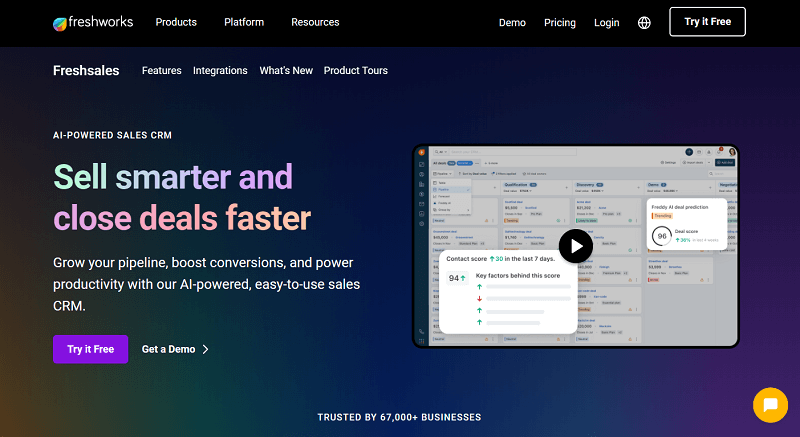
Freshworks provides Fresh CRM (previously Freshsales), a cloud-based platform that enables enterprises to manage contacts, track interactions, and automate workflows from a single system.
Freshworks CRM is designed to make relationship management easier by combining contact management, pipeline monitoring, communication tools, and automation functions in a single platform.
For credit unions, this means staff can access member information, track queries or loan prospects, and handle follow-ups without having to switch between systems.
Features of Freshwork CRM
-
Contact and Lead Management
Freshworks CRM keeps all member and prospect information in one location. Credit unions can save contact information, interaction history, notes, and engagement activities, giving staff a comprehensive picture of each member relationship. Lead management increases the continuity of branches, service teams, and digital platforms.
-
Sales Pipeline and Deal Tracking.
The CRM displays visual pipelines that indicate where each opportunity or service request is in the process. Credit unions can track loan inquiries, product interest, and follow-ups at certain stages, allowing teams to prioritize activities and avoid missed chances.
-
Workflow & Process Automation
Automation tools reduce repetitive work by triggering actions such as task assignments, follow-up reminders, status updates, and notifications. For credit unions, this ensures consistent handling of member inquiries, loan requests, and service cases.
4. Email & Communication Tracking
Freshworks CRM tracks emails, responses, opens, and clicks directly within the platform. Staff can use templates for consistent communication and see all correspondence tied to a member record, improving response quality and accountability.
| Pros of Freshworks CRM | Cons of Freshworks CRM |
|---|---|
| The UI is simple and intuitive to use. | Some users notice uneven customer support response. |
| Automation features save team time and effort. | Customization can be complicated and time-consuming. |
| The mobile app is popular for its usefulness. | Reporting capabilities may feel limited for your requirements. |
8. Capsule CRM: Best in Email Integration

Capsule CRM is a user-friendly customer relationship management (CRM) solution designed for small and medium-sized organizations. It provides a simple approach to managing sales and marketing activities that avoids overloading users with needless complexity.
Contact management, pipeline visualization, and lead tracking are all crucial aspects of Capsule CRM for improving sales effectiveness. This tool helps organizations organize customer data, strengthen client connections, and increase overall sales productivity.
Features of Capsule
Contact and Member Management
Capsule CRM collects member contact information, interaction history, and notes in one location. This enables credit unions to keep consistent data and promptly identify member needs during service encounters.
- Opportunity and Pipeline Tracking
The CRM offers simple pipeline views for tracking opportunities like loan inquiries, service requests, and membership follow-ups. This allows teams to see their progress at a glance and manage next steps more efficiently.
- Task and Reminder Management
Capsule allows personnel to create projects, make reminders, and schedule follow-ups. This ensures timely engagement with members and lowers the likelihood of missing actions.
- Email Integration
Capsule connects with email platforms, linking communication directly to member records. This keeps every correspondence visible and searchable in the CRM.
| Pros of Capsule CRM | Cons of Capsule CRM |
|---|---|
| Integrated Projects module for delivering work | Automation is less advanced than larger CRMs. |
| User-friendly UI. | Reporting is solid |
CRM for Credit Unions vs. Core Banking Systems: What’s the Difference?
| Feature | CRM for Credit Unions | Core Banking System |
|---|---|---|
| Primary Purpose | Manages member relationships, engagement, and interactions | Manages financial accounts, transactions, and records |
| Member Data View | 360-degree member profile including interactions, preferences, and history | Financial-only view (accounts, balances, transactions) |
| Transaction Processing | Not designed for transaction processing | Core function |
| Member Interaction Tracking | Tracks calls, emails, branch visits, and digital touchpoints | Very limited or none |
| Loan & Service Follow-Ups | Automates loan inquiries, reminders, and service workflows | Tracks loan data but limited engagement follow-up |
| Goal | Improve member experience, retention, and growth | Ensure accurate, compliant financial operations |
| Marketing & Engagement Tools | Built-in or integrated marketing automation | Not available |
Conclusion
Choosing the best CRM for credit unions is not just a tech choice. It is a strategic decision that affects member experience, operational efficiency, and long-term growth.
Credit unions are competing with fintechs and large banks. They need a system that emphasizes relationships. It’s not just about transactions.
The right CRM solution depends on your credit union’s size, complexity, and goals. Smaller credit unions may prioritize ease of use and affordability, while larger institutions often require advanced automation, deep customization, and enterprise-level reporting.
Ultimately, investing in the right CRM empowers credit unions to strengthen member relationships, improve internal efficiency, and remain competitive in an increasingly digital financial landscape.
Frequently Asked Questions
Yes, reputable CRM software for credit unions includes data encryption, role-based access controls, audit trails, and compliance features designed to protect sensitive member information and meet regulatory requirements.
While a CRM does not replace compliance systems, many credit union CRMs support NCUA compliance through secure data handling, audit trails, reporting, and access controls.
Small credit unions often benefit from CRMs that are easy to use and affordable, such as HubSpot CRM, Zoho CRM, Freshworks CRM, or Capsule CRM. These platforms offer essential features without heavy implementation complexity.